


Siding Replacement in Brimfield, MA
If the vinyl on your Brimfield house is cracked, bowed, or missing chunks near the ground, patching it won’t hold for long, and a full tear-off is usually the more honest answer. Brimfield’s mix of year-round lake homes and older seasonal cottages that got converted for full-time living tends to hide problems behind the siding, not just on top of it. Homes facing Sherman Pond or the Quaboag River take direct wind and driven rain on one side of the house, and that’s usually where the sheathing has taken the worst of it. We pull the old siding off, look at what’s actually there, and price the job on what we find, not on a guess.
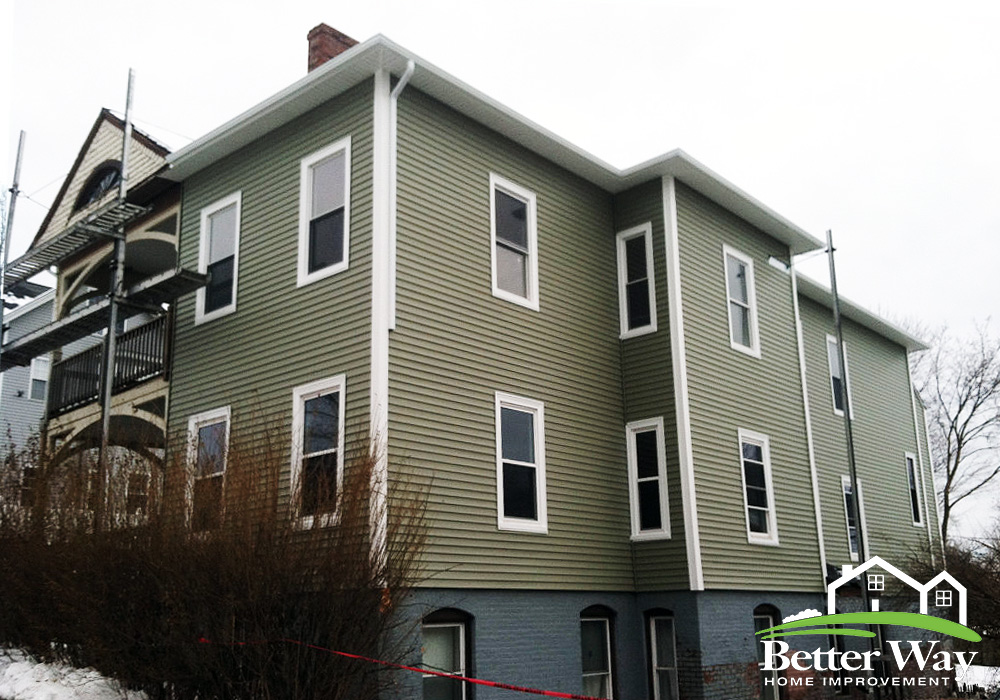
What Siding Replacement looks like in Brimfield
A replacement job here starts with stripping the existing siding down to the sheathing, not just the visible surface. On a lot of Brimfield’s older lake cottages that were never built as year-round homes, that sheathing is board sheathing with gaps, or thin plywood with no vapor barrier at all. We’re not surprised to find soft wood, old newspaper insulation, or bare studs on the water-facing wall of a place that’s been re-sided once already over the original material.
Once the old siding is off and hauled away, we check every wall for rot, moisture damage, and insect activity, not just the side that looks bad from the driveway. Any soft or damaged sheathing gets cut out and replaced before anything new goes up. We also check that there’s a proper weather-resistant barrier and, where it’s missing, we add one, because a lot of these homes were built or converted before that was standard practice.
The quote reflects two numbers: what we can see before we start, and a contingency range for what’s common on a home of that age and exposure. We don’t pad that number to cover ourselves, and we don’t lowball it to win the job and hit you with a change order later. If we open a wall and find something worse than expected, we stop, show you, and talk price before doing the work.
What we account for on Brimfield homes
Older vinyl over original clapboard
A common Brimfield replacement starts with vinyl that was installed over older wood siding. During removal, the crew checks what is underneath rather than assuming the original siding can simply be covered again. If the old clapboard is sound and the planned siding system allows it, it becomes part of the preparation decision. If it is damaged or no longer suitable as the base, the affected material is dealt with before the new siding goes on.
Sheathing and hidden wood damage
Water can reach the wall through failed siding, trim, flashing, or openings around windows and doors. By the time the exterior looks damaged, some deterioration may already be behind it. Tear-off provides an opportunity to inspect those areas. Soft or damaged sheathing and localized rot are repaired before the replacement siding covers the wall again. The purpose is simple: do not put a new exterior over a problem that should have been fixed first.
Older village homes and exterior details
Brimfield's village areas include older Victorian and Colonial Revival housing with more trim and architectural detail than a basic ranch. Those details affect removal, preparation, measurements, and installation. The replacement plan accounts for corners, window and door openings, trim, transitions, and other areas where a simple wall panel approach does not work. Older homes also deserve a closer look before removing material that may be part of the original exterior.
Removal, disposal, and site access
Replacement creates a different cleanup requirement from a repair. The old siding has to be removed, sorted and taken away, and the work area has to remain accessible while the exterior is open. The estimate accounts for removal and disposal rather than treating tear-off as an afterthought. On a typical Brimfield home, the crew works through the exterior in sections so the project can move from removal to preparation and then into the replacement phase.
What we account for on Brimfield homes
Site visit, replacement estimate
Homes around Brimfield vary in age, construction, and exposure, so no two siding jobs are identical. We look closely at wall orientation, existing sheathing condition, insulation gaps, and how previous work was done before pricing anything.
- Framing and sheathing condition
- Trim, flashing, and window details
- Moisture or insulation issues found underneath
Tear-off and wall inspection
Water-facing walls take the damage first
Houses near Sherman Pond, Foskett Pond, or the Quaboag River get sustained wind-driven rain on one elevation, season after season. That’s the wall we inspect closest before we ever write a number down, because it’s almost always where the sheathing rot shows up first, even when the siding on that side looks intact from a distance.
Replacement and cleanup
Converted cottages often have undersized framing
A lot of Brimfield’s lake-adjacent homes started as seasonal cabins and got winterized later. That means 2×3 or 2×4 wall framing built for summer use, not year-round New England weather. We flag this during tear-off, because it affects how much room there is for proper insulation and how the new siding needs to be fastened.
No vapor control behind the old siding
Homes converted from seasonal to year-round use frequently have no vapor barrier and little to no wall insulation. Moisture gets trapped between the old siding and the sheathing with nowhere to go, which speeds up rot. When we find this, we address it as part of the re-side rather than covering it back up.
Older homes may have layered siding
Some Brimfield properties have been re-sided over old cedar shingle or an earlier vinyl layer instead of a proper tear-off. We remove all of it, not just the top layer, so the new siding sits flat against sound sheathing instead of an uneven buildup underneath.
Frequently Asked Questions
How much does siding replacement cost in Brimfield?
Most full re-sides on single-family homes here run in the mid-to-high thousands, depending on square footage, how much sheathing repair is needed, and material choice between vinyl and fiber cement. We give an exact number after inspecting your walls, not before.
How long does a full siding replacement take?
A typical Brimfield home takes one to two weeks from tear-off to cleanup. Homes with multiple layers of old siding or significant sheathing repair take longer.
What happens if you find rot or damage behind my old siding?
We stop, show you what we found, and give you a price to repair it before continuing. On Brimfield's older lake-area homes, especially converted cottages, finding some sheathing damage on the water-facing wall is common enough that we plan for it in the initial estimate range.
Do converted lake cottages need anything different from a standard replacement?
Often yes. Many were built with lighter framing and no vapor barrier for year-round use. We address both when we find them, adding proper moisture protection as part of the re-side rather than covering the same problem back up.
Should I replace all four sides or just the damaged wall?
If only one elevation, usually the water-facing side, shows damage, a partial replacement can work, but matching old and new siding exactly is difficult after years of sun exposure. We'll give you an honest read on both options during the estimate.
How the job runs
Tear-off and inspection
We strip the old siding off the full house, or the sections being replaced, and inspect the sheathing wall by wall. This is usually a one-day job on an average single-family home, longer if there are multiple siding layers to remove.
Repair and prep
Any rotted or damaged sheathing gets cut out and replaced. We install or repair the weather-resistant barrier, address flashing around windows and doors, and make sure the wall is sound before anything new goes on. This step’s length depends entirely on what we find, one to three days is typical.
Installation and cleanup
New siding goes up, along with any trim, corner posts, and flashing detail work. We haul away every piece of old material and debris, we don’t leave it for the homeowner to deal with. A full re-side on an average Brimfield home usually runs one to two weeks start to finish, weather and material lead times permitting.
Recent work in and around Brimfield
A typical Brimfield job we run looks like this: a single-family home near one of the ponds, original vinyl siding installed in the 1980s or 90s, showing cracking and warping mostly on the water-facing side. On tear-off, we find sound sheathing on three walls and moisture-damaged sheathing on the fourth, along with no vapor barrier behind the old siding anywhere on the house. We replace the damaged sheathing sections, add a proper weather barrier across all four walls, and install new siding with reinforced fastening on the exposed elevation. That’s not a specific address or a named customer, it’s the pattern we see often enough in this town that we plan for it before we quote.
Other services we provide in Brimfield
If your siding is holding up but has isolated damage, take a look at our siding contractor in Brimfield page, which covers spot repair rather than full replacement. We also install James Hardie fiber cement siding for homeowners who want a material with more resistance to moisture and impact than standard vinyl, a common upgrade choice on Brimfield’s water-facing homes. Beyond siding, we handle seamless gutters, sized and installed to move water away from foundations that already deal with heavy runoff near the ponds, plus replacement windows and doors, often bundled into a siding project since the openings get touched during tear-off anyway.
Free estimates in Brimfield
Better Way Home Improvement is based in Brimfield, about 17.2 miles from Brimfield, and we work this area regularly. We’re licensed, insured, and an Angie’s List Super Service Award winner for 2013 through 2019. Estimates are free and based on an actual look at your walls, not a drive-by guess. Call (508) 506-8957 to set one up. We’ll walk the exterior, check the water-facing side first, and give you a number in writing before any work starts. For more on how a full replacement is scoped generally, see our siding replacement page.