


Vinyl Siding Installation in Hopkinton, MA
Most of the siding calls we get from Hopkinton come off the capes and colonials built between the 1970s and early 2000s around Lake Maspenock, Hayden Rowe, and the newer developments off Route 135. That vinyl is 20 to 40 years old now and it shows: chalky white streaks when you run a finger down the panel, color that’s gone patchy on the sun side, and panels that rattled loose in the last big storm. If your siding is doing any of that, a full installation resets the wall with product built for how these houses actually sit on their lots.

What Vinyl Siding Installation looks like in Hopkinton
Hopkinton lots tend to be bigger than what we see closer to Worcester, which is good news for staging trucks, scaffolding, and material laydown — it usually means a faster job with less juggling. Most of the homes we work on here are either original capes and ranches from the postwar boom that got re-sided once already in the 80s or 90s, or larger colonials built during Hopkinton’s growth years in the 90s and 2000s that are now due for their first replacement.
For installation we’re stripping the wall down to the sheathing, checking it, then building back up with housewrap, new flashing at every window and door, and a siding panel matched to the house. On Hopkinton jobs we lean toward a .044 or .046 gauge panel with a double 4 or double 5 profile depending on the home’s era — the older capes usually read better in a narrower reveal, the larger colonials can carry a wider one. Insulated panel is worth the upgrade on homes with thin original sheathing or rooms that run cold in winter; standard hollow-back panel is fine where the wall is already insulated well.
Color retention matters more to Hopkinton buyers than almost anywhere else we work — this is a town where people compare three quotes and read the warranty paperwork before they sign anything. We install product backed by a manufacturer fade warranty, and we walk through what that warranty actually covers before you commit, not after.
What we account for on Hopkinton homes
Original clapboard under older vinyl
One common condition on older Hopkinton homes is original clapboard underneath later vinyl siding. The existing layers need to be checked before new siding is installed. If the underlying material is sound and suitable, the installation can be planned around it. If there is deterioration or an uneven surface, that condition needs to be addressed before the new siding goes on.
Victorian and Colonial Revival details
Village-center homes often have more exterior details than a basic ranch. Porches, trim, windows, and changes in wall depth can affect how siding panels and accessories need to be laid out. J-channel, corner posts, and other trim are installed around those features so the new siding follows the house instead of making the house conform to a generic layout.
Aging 1970s and 1980s vinyl
Older vinyl can become brittle, faded, warped, or difficult to match. Replacement siding also gives homeowners an opportunity to update the panel profile, color, insulation, and exterior trim. The crew checks the existing siding and the areas around windows, doors, corners, and other transitions before establishing the installation plan.
Housewrap and flashing
Vinyl siding is not the waterproofing layer of the wall. Proper flashing and housewrap help manage water behind the siding. Before the panels are installed, the wall assembly and openings are considered so moisture problems are not simply hidden behind a new exterior.
What we account for on Hopkinton homes
Measure and plan
Hopkinton’s mix of older colonials and newer builds means every home is checked for wall squareness, moisture behind existing siding, and trim thickness. We factor in local weather exposure, roofline details, and existing insulation before recommending panel style and installation approach.
Prepare the exterior
Panel profile and gauge matched to the house era
A double 4 traditional profile on a 1970s cape reads differently than it does on a 2000s colonial with taller wall sections. We size the panel gauge and profile to the home’s proportions instead of installing whatever’s on the truck, and we’ll show you a sample against your actual wall before ordering.
Complete the details
Insulated vs. standard panel decisions
Homes with the original 1970s-era wall assemblies often have minimal sheathing insulation. On those we usually recommend insulated vinyl to close that gap without opening walls. Newer colonials with modern sheathing rarely need it — we’ll tell you honestly which category your house falls into.
J-channel and corner detailing on larger colonials
The bigger footprint colonials common in Hopkinton’s newer neighborhoods have more corners, more window returns, and more roof lines feeding into the wall than a simple cape. Clean J-channel work and properly mitered corner posts are what keep those transitions from looking patched together, and it’s where a lot of production crews cut time.
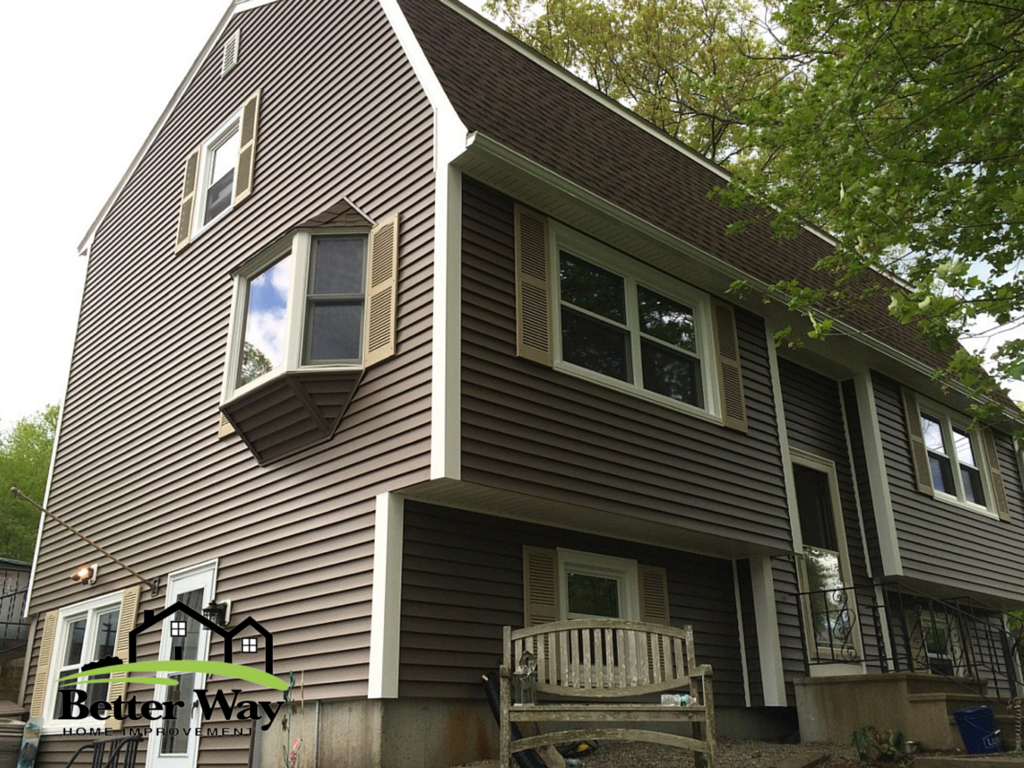
Housewrap and flashing on homes getting their second re-side
Most Hopkinton siding jobs are second- or third-generation — the original vinyl went up decades ago, sometimes over housewrap that’s now brittle or missing in spots. We replace it completely and re-flash every window and door head rather than tucking new panel over old wrap.
Frequently Asked Questions
What panel gauge and profile do you recommend for Hopkinton homes?
Most Hopkinton capes and ranches look right in a double 4 traditional profile at .044 to .046 gauge. Larger 90s and 2000s colonials with taller wall sections can carry a double 5 profile without looking off. We size it to the house rather than defaulting to one option.
Is insulated vinyl siding worth it on an older Hopkinton cape?
Often yes. Many 1970s-era capes have thin original sheathing insulation, and insulated vinyl panel closes some of that gap without opening up interior walls. Newer colonials with modern sheathing usually don't need the upgrade, and we'll tell you which situation applies to your house.
How much does vinyl siding installation cost in Hopkinton?
It depends on the home's size, the panel chosen, and how much sheathing repair is needed once the old siding comes off. A typical cape or ranch runs less than a large colonial with more corners and trim work. We give an exact number after measuring, not a phone estimate.
What happens if you find damage behind the old siding?
On second-generation re-sides in Hopkinton, we find soft or water-stained sheathing often enough that we expect it, usually near gutters, chimneys, or old flashing. We stop, show you the damage, and quote the repair separately before covering it back up. We don't install new panel over a wall we haven't checked.
How long does a full siding installation take on a Hopkinton house?
A standard cape or ranch runs 3 to 5 days. Larger colonials with more roof lines and window returns typically run a week to ten days, mostly depending on weather and how much trim detail the house has.
How the job runs
Walkthrough and measure, day one. We inspect the existing siding, check the sheathing where we can, measure every wall and opening, and go over panel profile and gauge options on the spot.
Tear-off and wall prep, day two. Old panel and trim come off, the sheathing gets inspected and repaired where needed, and new housewrap goes on with all seams taped.
Install and trim-out, remaining days. Panel goes up starting at the bottom course, working up with proper overlap and nailing, then J-channel, corner posts, and trim get finished around every window, door, and roofline. A typical Hopkinton cape or ranch runs 3 to 5 days; larger colonials with more corners and dormers can run a week to ten days depending on weather and crew size.
Recent work in and around Hopkinton
A common job we run in Hopkinton is a full re-side on a 1980s-built cape near Lake Maspenock — original vinyl chalking badly on the south and west walls, some soft sheathing found at the base of one gable where a gutter had been overflowing for years. We replaced the damaged sheathing section, wrapped the whole house fresh, and installed insulated double 4 panel in a color the homeowner matched off a fan deck rather than guessing from a photo. That’s the pattern here more often than not: the vinyl looks tired everywhere, but the real damage is usually confined to one or two spots where water had been getting behind it.
Other services we provide in Hopkinton
If your siding is newer or you’re only dealing with damage in a few sections, our siding repair service in Hopkinton may be the better fit rather than a full re-side. When the whole wall system needs to come off — old panel, old housewrap, and all — that’s a siding replacement project, which is a different decision than installing new siding on a wall that’s already been stripped. We also install James Hardie fiber cement siding for homeowners who want a different material entirely, and we handle seamless gutter installation and repair and replacement windows and doors — both worth bundling into a siding project since the crew and staging are already on site.
Free estimates in Hopkinton
We’re based at 152 Sutton Ave in Hopkinton, about 19.1 miles from Hopkinton — close enough that we’re in town regularly for estimates and installs. Call (508) 506-8957 and we’ll set up a free, no-pressure estimate. Someone comes out, measures the house, looks at the current siding and sheathing where visible, and gives you a written quote with panel options and a real timeline — no guesswork, no upsell script. We’re licensed and insured, and we’ve been an Angie’s List Super Service Award winner every year from 2013 to 2019.