


Vinyl Siding Installation in Millville, MA
If you own one of Millville’s mill-era worker cottages or a triple-decker near the Blackstone River, chances are you’re looking at original wood clapboard nailed straight over board sheathing, no housewrap, and probably a layer of lead paint if the house went up before 1978. That’s the starting point for most vinyl siding installation quotes in this town, and it changes how the job gets bid and how it gets built. A straight re-side over what’s there usually isn’t an option here — the wall almost always needs to come down to sheathing first.

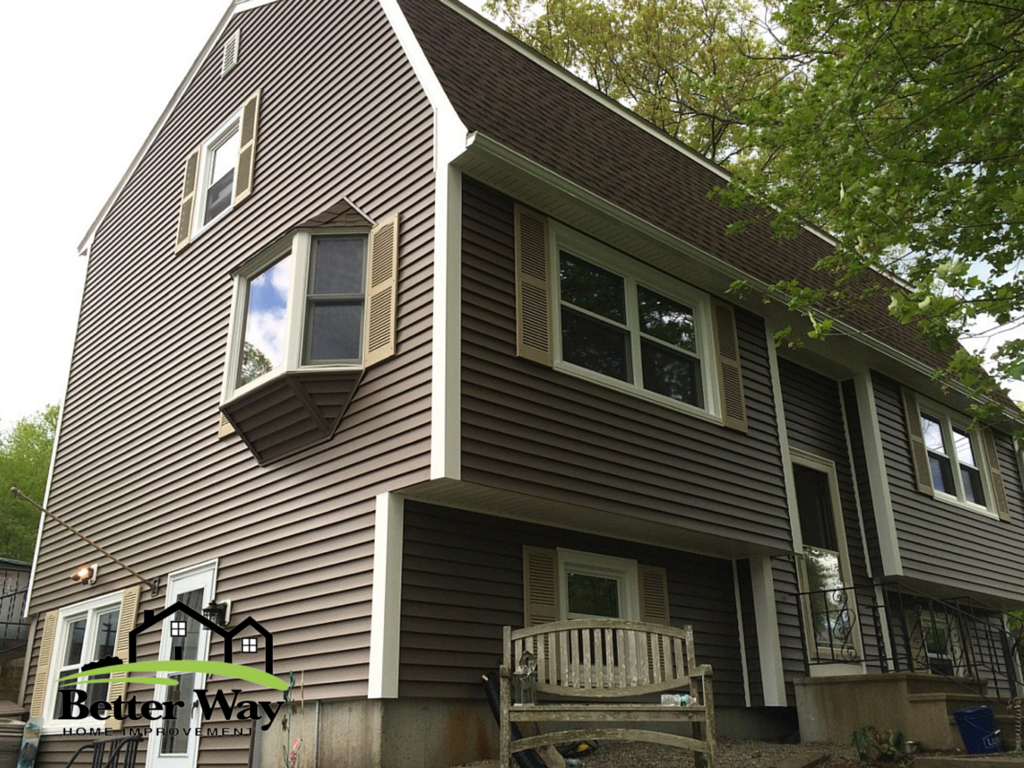
What Vinyl Siding Installation looks like in Millville
Most Millville jobs start the same way: strip the old clapboard, inspect the sheathing, and find out what’s actually holding the house up. On a lot of these homes that’s true board sheathing from the 1890s to 1920s, sometimes solid, sometimes soft at the bottom courses where moisture worked in over decades. Once the wall is open we install synthetic housewrap — something these houses never had — lapped and taped correctly, then flash every window and door before a single panel goes up.
For the panel itself, we install .044 to .046 gauge vinyl on these homes rather than the thin builder-grade .040 stock, because the tighter lots and closer spacing between houses in Millville mean people notice waviness and oil-canning up close. Insulated vinyl siding is worth discussing here too — the extra rigid foam backing stiffens the panel, adds an R-value bump, and helps flatten out walls that have settled unevenly over a century. Standard hollow-back panel is a reasonable choice for a garage, an addition, or a budget-driven job, but on the main house we usually steer people toward insulated.
Color retention matters more than people expect. Manufacturers bake UV inhibitors into the vinyl resin and back that with a fade warranty, typically prorated over the life of the product. We go over what that warranty actually covers before you pick a color, because darker colors fade faster and that’s a real consideration on a house with a lot of southern exposure. Every job finishes with proper J-channel at trim and window returns, correctly sized outside corner posts — undersized corners are a common shortcut on older re-sides and we don’t do it — and starter strip set level even when the sill below it isn’t.
What we account for on Millville homes
Original clapboard under older vinyl
One common condition on older Millville homes is original clapboard underneath later vinyl siding. The existing layers need to be checked before new siding is installed. If the underlying material is sound and suitable, the installation can be planned around it. If there is deterioration or an uneven surface, that condition needs to be addressed before the new siding goes on.
Victorian and Colonial Revival details
Village-center homes often have more exterior details than a basic ranch. Porches, trim, windows, and changes in wall depth can affect how siding panels and accessories need to be laid out. J-channel, corner posts, and other trim are installed around those features so the new siding follows the house instead of making the house conform to a generic layout.
Aging 1970s and 1980s vinyl
Older vinyl can become brittle, faded, warped, or difficult to match. Replacement siding also gives homeowners an opportunity to update the panel profile, color, insulation, and exterior trim. The crew checks the existing siding and the areas around windows, doors, corners, and other transitions before establishing the installation plan.
Housewrap and flashing
Vinyl siding is not the waterproofing layer of the wall. Proper flashing and housewrap help manage water behind the siding. Before the panels are installed, the wall assembly and openings are considered so moisture problems are not simply hidden behind a new exterior.
What we account for on Millville homes
Measure and plan
Millville’s mix of older farmhouses and newer builds means every wall assembly is different. We check framing squareness, existing sheathing condition, water table height, and utility penetrations so panels lay flat and drainage works properly year-round.
Prepare the exterior
Lead paint on pre-1978 siding
Most of Millville’s mill housing predates 1978, which means lead paint disclosure and containment rules apply the moment we start tearing off original clapboard. Our crew follows EPA RRP lead-safe work practices — plastic sheeting, containment, and proper disposal — as standard procedure on this stock, not as an upsell.
Complete the details
No housewrap under the old siding
Board sheathing with nothing but old clapboard over it is normal here, not an exception. We treat every tear-off as a chance to install housewrap correctly, since it’s often the first time the wall has had any real weather barrier since it was built.
Undersized rakes and window returns
A lot of these cottages were trimmed thin to begin with, and rakes and window casings sized for clapboard don’t always leave enough depth for standard J-channel. We rip trim stock and build out returns where needed so the panel terminates cleanly instead of getting crammed against undersized wood.
Rot at the sill from grade creep
Decades of landscaping, driveway paving, and yard fill have pushed grade up against a lot of these foundations, and the bottom plate and sill often show it once siding comes off. We replace rotted sill and sheathing sections before siding goes back on — patching over it just moves the problem behind new vinyl.
Frequently Asked Questions
Does vinyl siding installation cost more when there's lead paint under the old siding?
Usually, yes. Lead-safe tear-off on pre-1978 homes requires containment and disposal steps that take more labor time than a standard strip. We flag it during the estimate so there's no surprise once work starts, and it's a normal line item on most Millville quotes given how much of the housing stock predates 1978.
What happens if you find rot or bad sheathing once the old siding comes off?
On Millville's older housing stock, finding something behind the siding is close to routine rather than rare. We stop, show you what we found, and give you a price to repair it before panel goes back up. We don't guess at hidden damage in the original estimate and we don't cover it over.
How long does a full vinyl siding installation take on a Millville house?
A typical single-family runs about a week from tear-off to finished trim, longer if sill or sheathing repair is needed. Multi-family homes and triple-deckers take longer because of added wall area and window count.
What does vinyl siding installation cost in Millville?
It depends heavily on square footage, whether sheathing repair is needed, and standard versus insulated panel. Because so many houses here need sheathing and sill work once the old clapboard comes off, an accurate number really requires an in-person look rather than a phone estimate.
Is insulated vinyl siding worth it on an older Millville home?
Often yes. Insulated panel stiffens up on walls that have settled unevenly over a century and adds some R-value, which matters on houses with little to no existing wall insulation. It costs more than standard panel, and we'll go over the difference in price during your estimate.
How the job runs
Site setup and staging
Narrow driveways and tight lots in Millville mean staging is the first problem we solve, not an afterthought. We walk the property before scheduling to figure out dumpster placement, material staging, and where the crew truck can actually sit without blocking a neighbor’s only access.
Tear-off and wall prep
Old siding comes off, sheathing gets inspected and repaired where soft, housewrap goes up, and every window and door gets flashed. On a typical single-family this takes one to two days; triple-deckers run longer because of the wall area and the extra window count.
Installation and finish work
Panel installation on a house this size usually runs three to five working days depending on complexity, trim detail, and weather. We do final trim, corners, and a walk-through with you before we call it done, and the dumpster and staging materials clear out the same week.
Recent work in and around Millville
A typical job we run in Millville is a full tear-off on a pre-1930s worker cottage or two-family: strip original clapboard, find and repair sill rot at one or two corners where grade has crept up, install housewrap the house never had, and side it in insulated vinyl with rebuilt trim at the rakes and window returns. We’re not going to invent a customer name or an address to make this sound more specific than it is — every house on these streets has some version of the same story, and that’s exactly why the tear-off-to-sheathing approach is the default here rather than the exception.
Other services we provide in Millville
Siding is rarely the only thing going on with a house this old. If the panel is intact but a section got damaged by a storm or a ladder, our siding repair service handles patch-in work without a full tear-off. If the whole wall system is failing — not just the surface — our siding replacement page covers the tear-off decision in more depth. We also install James Hardie fiber cement siding for homeowners who want a heavier, more fire-resistant product than vinyl, and we handle seamless gutter installation and repair alongside a siding job, since old fascia and gutter systems on these houses usually need attention at the same time. Replacement windows and doors round out most full-wall projects — ask about it when you call.
Free estimates in Millville
We’re based in Millville, about 15.9 miles from Millville, and this town is inside our regular service area — not a special trip. Call (508) 506-8957 for a free estimate. We’ll set a time to walk the house, look at the existing siding and sheathing, and give you a written price before you decide anything. No pressure, no obligation, and if you’re comparing quotes we’re glad to be one of them.