


Vinyl Siding Installation in Upton, MA
Upton sits on the eastern edge of our service area, close enough to Milford and Bellingham that a lot of the housing here is newer and denser than what we see in the mill towns to the west. That means postwar colonials, some condo and townhouse clusters, and in more than a few cases an association that has a say in what color and material goes on the wall. If you own a freestanding home here you’re often dealing with siding that was never top-tier to start, put up fast during a building push in the 60s through the 90s. If you’re in an association, the first real question isn’t panel style. It’s what’s approved.

What Vinyl Siding Installation looks like in Upton
Most Upton installs we quote fall into two camps: a single-family home replacing tired builder-grade siding, or a townhouse unit where the exterior finish has to match, or come close to matching, a rule someone wrote down years ago. Either way the product conversation is the same. We install .044 to .046 gauge panel as our standard, thicker than what’s on most of these homes now, in either a traditional 4-inch clapboard profile or a double 4.5-inch profile depending on what looks right on the house. For anyone who wants better rigidity and a flatter look against the wall, we go with insulated vinyl, which has a foam backing laminated to the panel instead of a hollow channel.
Color matters more here than in the towns without associations. We carry lines with lifetime color-retention warranties that specifically cover fade, because a lot of these developments were built with darker colors that faded unevenly over 20-plus years, and that unevenness is usually the actual complaint even when the homeowner describes it as “the siding is failing.” We also pay attention to trim detail on these homes — J-channel around windows, proper corner posts instead of butted seams, and starter strip set level so the whole first course reads straight from the street. On a denser street like the ones off Main Street or near the town common, sloppy corner work is the kind of thing a neighbor notices in a week.
What we account for on Upton homes
Original clapboard under older vinyl
One common condition on older Upton homes is original clapboard underneath later vinyl siding. The existing layers need to be checked before new siding is installed. If the underlying material is sound and suitable, the installation can be planned around it. If there is deterioration or an uneven surface, that condition needs to be addressed before the new siding goes on.
Victorian and Colonial Revival details
Village-center homes often have more exterior details than a basic ranch. Porches, trim, windows, and changes in wall depth can affect how siding panels and accessories need to be laid out. J-channel, corner posts, and other trim are installed around those features so the new siding follows the house instead of making the house conform to a generic layout.
Aging 1970s and 1980s vinyl
Older vinyl can become brittle, faded, warped, or difficult to match. Replacement siding also gives homeowners an opportunity to update the panel profile, color, insulation, and exterior trim. The crew checks the existing siding and the areas around windows, doors, corners, and other transitions before establishing the installation plan.
Housewrap and flashing
Vinyl siding is not the waterproofing layer of the wall. Proper flashing and housewrap help manage water behind the siding. Before the panels are installed, the wall assembly and openings are considered so moisture problems are not simply hidden behind a new exterior.
What we account for on Upton homes
Measure and plan
Upton’s mix of older farmhouses and newer builds means wall surfaces, trim depths, and framing quality vary from house to house. We check for uneven sheathing, moisture behind existing panels, and window and corner details before locking in materials.
Prepare the exterior
HOA and association color approval
A real share of our Upton estimates start with a phone call to a property manager, not a homeowner. If your unit is part of an association, we ask for the approved color and material list before we quote anything, and we build the estimate around what’s actually allowed rather than what a homeowner likes best. It saves a change order later and it keeps the job from stalling at the paperwork stage.
Complete the details
Matching adjacent units
In townhouse rows, a color that’s technically “approved” can still look wrong next to the unit beside it if the manufacturer has shifted its formulation over the years. We bring physical samples on site and hold them against the neighboring wall in daylight before we order material, not after.
Denser lot lines and tighter access
Postwar development in Upton often means houses set closer together than the older farm-lot homes further out. That affects staging, dumpster placement, and how we run scaffolding on two-story sections. We plan the drop and haul-away route as part of the estimate, not as a surprise on install day.
Mixed vintage of the original wall
Some Upton streets were built in phases, so a house that looks uniform from the road can have an addition with different sheathing or a different housewrap generation underneath the existing siding. We check this at the first walk-around, not after we’ve already ordered panel.
Frequently Asked Questions
Does my HOA or condo association need to approve the siding color before you install it?
If your property is part of an association, yes, in almost every case. We ask for the approved color and material list before we finalize a quote, and we can work directly with a property manager if that's easier for you.
What thickness or gauge of vinyl siding do you install?
Our standard is .044 to .046 gauge, thicker than most of the original siding on Upton homes built from the 60s through the 90s. We also offer insulated vinyl with a foam backing for homes that want a flatter look and slightly better rigidity.
How much does vinyl siding installation cost in Upton?
Most single-family homes run in the range of a full-day multi-thousand-dollar project depending on square footage, trim complexity, and whether insulated panel is used. We give an exact number after measuring on site, not before.
How long does a vinyl siding installation take?
A typical single-family home takes 3 to 5 working days. Townhouse or condo units usually run 2 to 3 days depending on size and the amount of trim detail required.
What happens if you find damage behind the old siding?
We stop and show you what we found before we go further. On homes this age it's common to find soft sheathing or old flashing near windows and corners. We quote the repair as a separate line item so you know the cost before we proceed, rather than absorbing a surprise into the original number.
How the job runs
Walk-through and measure
We measure every wall plane, check the condition of the sheathing where we can see it at corners and penetrations, and confirm HOA or association requirements if they apply. This is also when we pull samples for a color match against neighboring units if needed. Most Upton walk-throughs run 45 minutes to an hour.
Prep and wrap
Old siding comes off, we inspect the wall, and we install or repair housewrap and flashing at every window, door, and roof intersection before a single new panel goes up. This step gets skipped by low-bid crews more than any other, and it’s the one that determines whether the wall stays dry for the next 20 years.
Installation and detail work
Panels go up with proper nailing slots left un-cinched so the vinyl can expand and contract with temperature. Corners, J-channel, and trim get set last so the reveal lines are straight. A typical single-family Upton home runs 3 to 5 working days start to finish; a townhouse unit is often 2 to 3 days depending on square footage and how much trim detail the association style requires.
Recent work in and around Upton
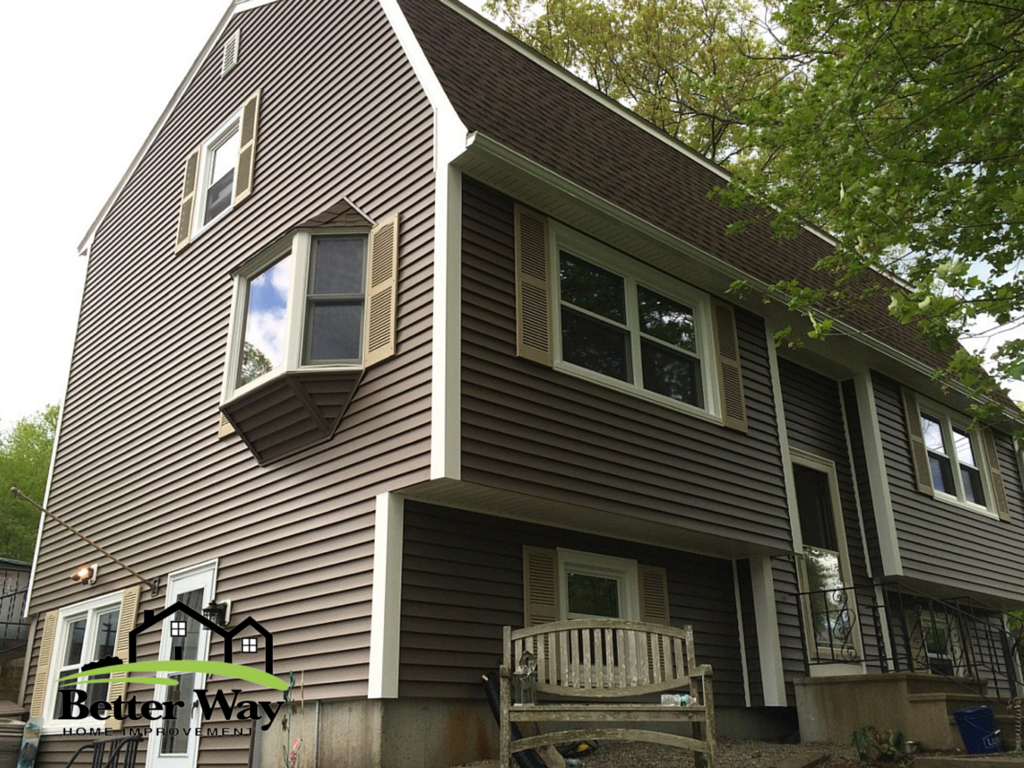
A common job for us in this part of town is a colonial from the 70s or 80s where the original aluminum or first-generation vinyl has chalked out and the panels have started to bow on the sun-exposed side. We strip it back to the sheathing, replace any water-damaged board we find near the old flashing points, wrap the whole wall correctly, and go back up with insulated panel in a color pulled from the current approved list where one applies. We’ve also handled association-driven re-siding where the scope was set by a management company ahead of time and our job was to execute it to spec and match the building next door.
Other services we provide in Upton
If your siding has isolated damage rather than whole-wall failure, our siding repair service in Upton may be the more honest fix. When the whole exterior is due for replacement and you’re weighing tear-off decisions rather than product choice, see our siding replacement page for Upton. We also install James Hardie fiber cement siding for homeowners who want a non-vinyl option, and we handle seamless gutter installation and repair and replacement windows and doors as part of the same exterior scope, which is common when a wall project uncovers window flashing that needs attention too.
Free estimates in Upton
Upton is about 14.0 miles from our shop in Upton, and it’s a regular stop for us. If you want a firm number instead of a guess, call (508) 506-8957 for a free estimate. We’ll ask a few questions about your home or unit, including whether an association applies, and get a crew out to measure and give you a written quote. No pressure, no obligation, and no charge for the visit.