


Vinyl Siding Installation in New Braintree, MA
New Braintree has almost no commercial strip and almost no shelter from wind. Most of the housing stock is antique colonials, capes, and farmhouses set back on long open lots with fields or stone wall on at least one side. When a nor’easter or a summer squall comes through, it hits the whole wall face at once with nothing to break it up first. That matters for vinyl siding installation here more than in a town with tighter lots and mature tree cover, because the fastening and panel choice have to account for wind load the manufacturer’s minimum spec doesn’t always cover.

What Vinyl Siding Installation looks like in New Braintree
Most of the calls we get from New Braintree start with a homeowner who has 1970s or 1980s vinyl on a house that’s a lot older than the siding. The panels are chalky, some are bowed off the wall, and there’s a hairline gap at every corner post. The house underneath is often a Cape or a center-chimney colonial with hand-hewn framing that was never perfectly square to begin with, so the siding job is really two jobs: getting a true, flat plane to nail to, and then installing panels that can take real wind without oil-canning or popping loose.
We install .044 to .046 gauge panels as a baseline on New Braintree jobs, not the thinner .040 stock some contractors quote to win price comparisons. On the exposed sides of a property — usually whichever wall faces the open field or the prevailing weather — we’ll spec a heavier panel or go insulated. Insulated vinyl adds a foam backer that stiffens the panel and helps it track straighter over an uneven wall, which is common on this stock. It also closes some of the thermal gaps that a 200-year-old wall assembly never had insulation for in the first place.
Color retention matters more out here than it does closer to town, because these houses often sit with full sun exposure on one or two walls all day with no shade line. We use panels with a fade-resistant cap layer and a written color warranty, not just a base manufacturer’s warranty on the resin. Corner posts, J-channel, and trim get cut and fitted to the actual wall dimensions rather than snapped to a standard reveal, because the walls on a 19th-century farmhouse are rarely a consistent height from corner to corner.
What we account for on New Braintree homes
Original clapboard under older vinyl
One common condition on older New Braintree homes is original clapboard underneath later vinyl siding. The existing layers need to be checked before new siding is installed. If the underlying material is sound and suitable, the installation can be planned around it. If there is deterioration or an uneven surface, that condition needs to be addressed before the new siding goes on.
Victorian and Colonial Revival details
Village-center homes often have more exterior details than a basic ranch. Porches, trim, windows, and changes in wall depth can affect how siding panels and accessories need to be laid out. J-channel, corner posts, and other trim are installed around those features so the new siding follows the house instead of making the house conform to a generic layout.
Aging 1970s and 1980s vinyl
Older vinyl can become brittle, faded, warped, or difficult to match. Replacement siding also gives homeowners an opportunity to update the panel profile, color, insulation, and exterior trim. The crew checks the existing siding and the areas around windows, doors, corners, and other transitions before establishing the installation plan.
Housewrap and flashing
Vinyl siding is not the waterproofing layer of the wall. Proper flashing and housewrap help manage water behind the siding. Before the panels are installed, the wall assembly and openings are considered so moisture problems are not simply hidden behind a new exterior.
What we account for on New Braintree homes
Measure and plan
Older farmhouses and rural properties around New Braintree often have uneven sheathing, settled framing, and mixed siding layers underneath. We factor in wall condition, existing trim, soffit and fascia fit, and drainage details so the new siding sits flat and sheds water properly.
Prepare the exterior
Out-of-square walls and furring
Original hand-framed walls in this part of Worcester County are almost never plumb or square by modern standards. We check every wall face with a straightedge before we start hanging panel, and where the plane is off we fur it out rather than let the siding telegraph the wave underneath. Skipping this step is the single biggest reason old vinyl jobs in New Braintree look rippled a few years in.
Complete the details
Wind exposure on open lots
A lot of New Braintree properties have one full wall with no windbreak — facing a field, a pasture, or open road frontage. On those walls we increase fastener spacing density, use heavier gauge panel, and make sure every piece is face-nailed correctly rather than hung loose to allow for expansion in a way that invites wind to get under it. This is a code-minimum-plus approach, not a fancy upsell.
Historic district and center-of-town rules
New Braintree’s town center falls under scrutiny from local historic commission guidance on some properties, particularly anything visible from the common. Where that applies we work with approved colors and profiles before we order material, so there’s no surprise at inspection or at resale.
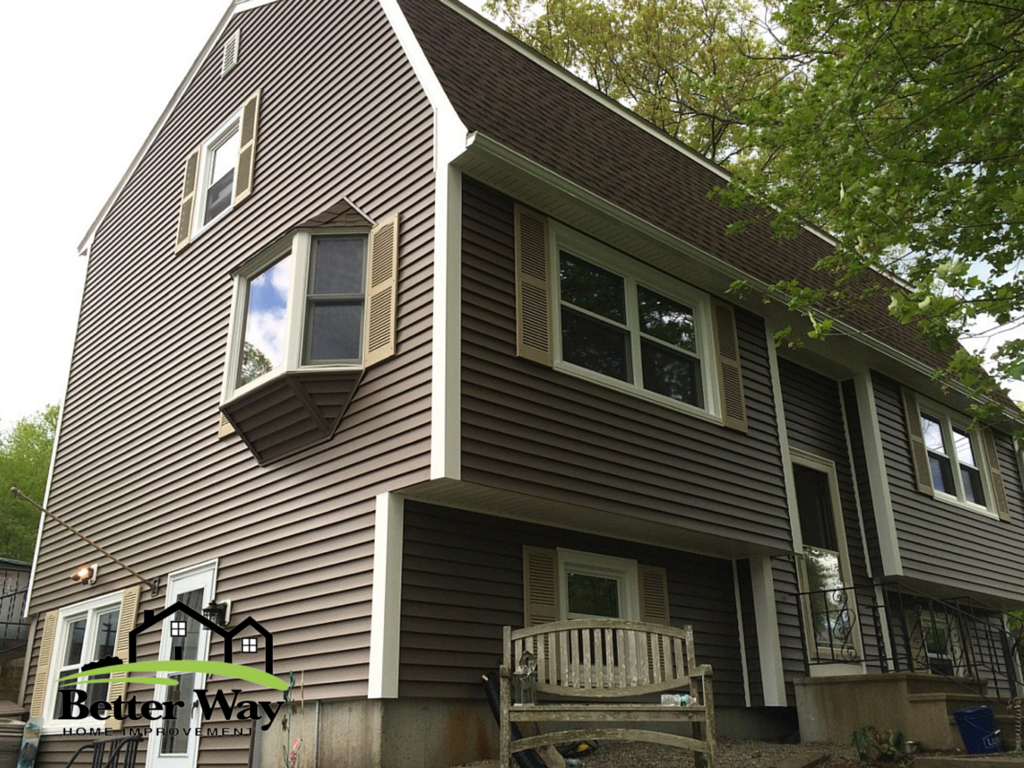
What's behind the old siding
On pre-1900 houses we routinely find board sheathing, sometimes with old cedar shingle or even earlier clapboard still nailed underneath the vinyl that came later. We also see original housewrap or building paper that’s degraded to nothing. Every full installation includes new housewrap and correct flashing at windows, doors, and any wall penetration before a single panel goes up — this is not optional and it is priced into the estimate from the start, not added later as a surprise line item.
Frequently Asked Questions
What does vinyl siding installation cost in New Braintree?
Most full-wall jobs on New Braintree homes run in the range of typical New England installation pricing per square, but the real driver here is wall condition, not the siding itself. Out-of-square framing, sheathing repair, and furring add labor that a simple ranch house wouldn't need. We give exact numbers after a walk-through, not before.
How long does a full siding installation take on an antique house?
Plan on 3 to 5 working days for a typical single-family home. Farmhouses with additions built at different periods, or houses needing significant furring to true up the walls, can run a few days longer.
What if you find rot or old sheathing problems once the siding comes off?
On New Braintree's older housing stock, we usually do find something — soft board sheathing near a window, old shingle layers, or degraded building paper. We stop, show you what we found, and quote the repair before continuing rather than covering it over.
Does New Braintree's historic district affect what siding I can install?
Some properties near the town center fall under local historic commission guidance on visible exterior changes. If your property is affected, we confirm acceptable colors and profiles with you before ordering material so there's no issue later.
Is insulated vinyl worth it on an old farmhouse with no wall insulation?
Often yes, on exposed walls. Insulated panel adds rigidity that helps it lie flat over an uneven old wall plane and closes some thermal gaps, though it isn't a substitute for proper wall insulation if that's a separate goal.
How the job runs
A typical New Braintree full-wall installation runs in three stages. First, we strip the existing siding down to sheathing and do a hands-on wall assessment — this is where out-of-square framing, rot, and any hidden material get identified. Second, we install housewrap, flash all openings, fur out any wall plane that needs it, and hang the new panel starting from a level chalk line rather than the old reveal marks. Third, we finish trim, corners, and J-channel, then walk the whole property with the homeowner before we call it done. For a typical single-family home this runs 3 to 5 working days depending on wall square footage and how much furring the walls need — a farmhouse with several additions built at different times will run longer than a simple four-square Cape.
Recent work in and around New Braintree
A common job type out here is a full-wall re-side on a center-chimney colonial or Cape where the existing vinyl is 30-plus years old and starting to crack at the corner posts. The scope usually includes full tear-off, sheathing repair where board sheathing has soft spots near old window openings, new housewrap, and insulated or heavy-gauge panel with a color-matched or updated palette. We’ve also done smaller scope jobs limited to one exposed wall facing open field where the rest of the siding is holding up fine but that one face has failed early from sun and wind. We do not publish customer names or addresses, but this profile — antique frame, one exposed face, hidden sheathing issues once we open it up — describes the majority of the work we’ve done in this part of the county.
Other services we provide in New Braintree
Full-wall vinyl installation isn’t the only call we get out here. If your existing siding is sound but has isolated cracked or missing panels, that’s a repair job, not a full install — see our siding repair page for that scope. If you’re weighing whether to repair or fully replace aging siding, our siding replacement page walks through that decision. Some New Braintree homeowners pair a siding project with James Hardie fiber cement siding on street-facing walls for a different look and a Class A fire rating. We also handle seamless gutters and replacement windows and doors, both of which often come up during a siding tear-off once the old trim is exposed.
Free estimates in New Braintree
We’re based at 152 Sutton Ave in New Braintree, about 19.4 miles from New Braintree center. That’s a normal drive for our crews and doesn’t change what we quote. Call (508) 506-8957 for a free, no-pressure estimate. We’ll walk the exterior with you, look at what’s actually under the existing siding wherever we can check a corner or a loose panel, and give you a written quote with panel gauge, color, and scope spelled out — not a ballpark number over the phone. If you decide to move forward, we schedule around your timeline and confirm material lead time before we set a start date.