


Siding Replacement in Clinton, MA
Clinton’s housing stock runs from tight-lot triple deckers and old mill worker cottages near downtown to capes and colonials out toward the reservoir. A lot of that vinyl went up in the 1980s and 90s during the first wave of re-siding, and it’s now chalky, faded on the south and west faces, or cracked from wind coming off the Wachusett Reservoir. When that siding is 25-plus years old and the seams have opened up, patching it stops making sense. Full replacement is the point where you stop chasing leaks panel by panel and deal with the wall itself.
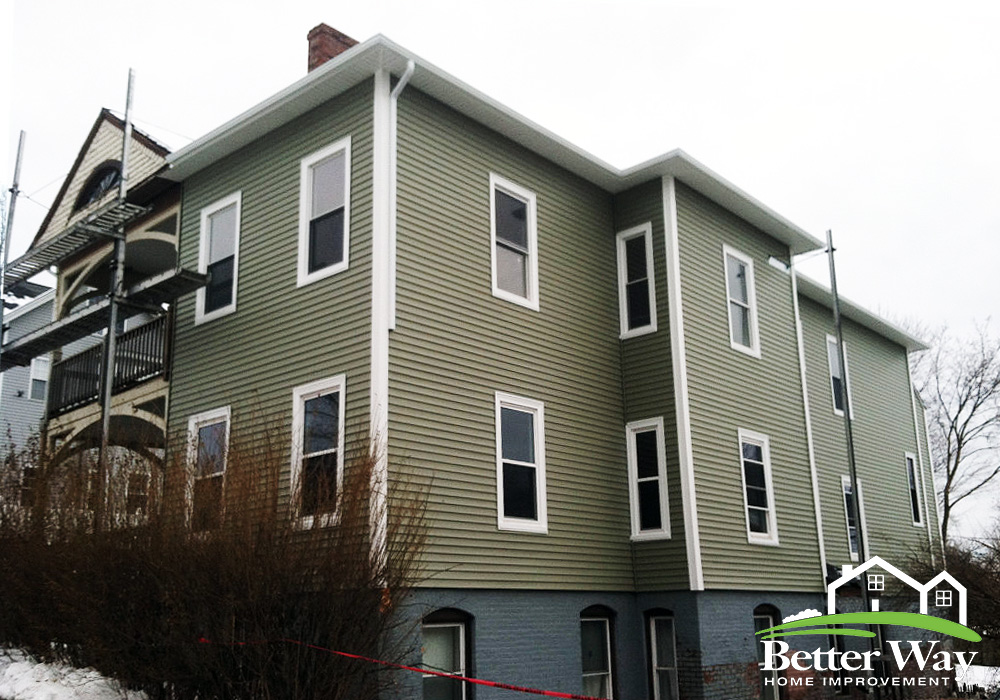
What Siding Replacement looks like in Clinton
A replacement job starts with tear-off, not measurements for new panels. On Clinton’s older homes — especially the mill-era housing near Church Street and the neighborhoods built up around the Bigelow Carpet-era workforce — we’re often pulling off two layers: the original wood clapboard or cedar shingle, and a vinyl or aluminum layer installed over it decades later without removing what was underneath. That double layer hides a lot. It hides rot at window sills, it hides sheathing that’s gone soft from years of moisture trapped between layers, and on the oldest homes it can hide horsehair plaster patches or old board sheathing that’s never been insulated.
Once the old siding is off, we inspect the sheathing board by board. Soft or delaminated sections get cut out and replaced before anything new goes up — no wrapping siding over a wall that won’t hold a nail. Homes built after the 1970s tend to have plywood or OSB sheathing in better shape, but the capes and colonials from that era still show nail pops and moisture staining around old window flashing that was never done right the first time. We document what we find with photos before we close the wall back up, so the homeowner sees exactly what was under there and why it needed doing.
Disposal is part of the quote, not an add-on. Old siding, especially layered wood-over-vinyl, is heavier and bulkier than people expect — a typical cape generates several dumpster loads. That gets hauled off site as part of the job, and the price reflects it up front rather than as a surprise change order once we’re mid-tear-off.
What we account for on Clinton homes
Older vinyl over original clapboard
A common Clinton replacement starts with vinyl that was installed over older wood siding. During removal, the crew checks what is underneath rather than assuming the original siding can simply be covered again. If the old clapboard is sound and the planned siding system allows it, it becomes part of the preparation decision. If it is damaged or no longer suitable as the base, the affected material is dealt with before the new siding goes on.
Sheathing and hidden wood damage
Water can reach the wall through failed siding, trim, flashing, or openings around windows and doors. By the time the exterior looks damaged, some deterioration may already be behind it. Tear-off provides an opportunity to inspect those areas. Soft or damaged sheathing and localized rot are repaired before the replacement siding covers the wall again. The purpose is simple: do not put a new exterior over a problem that should have been fixed first.
Older village homes and exterior details
Clinton's village areas include older Victorian and Colonial Revival housing with more trim and architectural detail than a basic ranch. Those details affect removal, preparation, measurements, and installation. The replacement plan accounts for corners, window and door openings, trim, transitions, and other areas where a simple wall panel approach does not work. Older homes also deserve a closer look before removing material that may be part of the original exterior.
Removal, disposal, and site access
Replacement creates a different cleanup requirement from a repair. The old siding has to be removed, sorted and taken away, and the work area has to remain accessible while the exterior is open. The estimate accounts for removal and disposal rather than treating tear-off as an afterthought. On a typical Clinton home, the crew works through the exterior in sections so the project can move from removal to preparation and then into the replacement phase.
What we account for on Clinton homes
Site visit, replacement estimate
Clinton’s mix of older mill housing and newer construction means no two siding jobs are quite the same. We look closely at wall structure, existing layers, insulation gaps, and how each home has held up to New England weather over time.
- Wall framing and sheathing condition
- Existing trim, corners, and flashing details
- Insulation and moisture barrier needs
Tear-off and wall inspection
Layered siding on mill-era homes
Homes near the downtown mill district often have two or three layers of siding stacked over the original wood. We factor extra tear-off time and disposal weight into the quote from the start rather than discovering it mid-job and re-pricing on the fly.
Replacement and cleanup
Older board sheathing and possible lead paint
Pre-1978 homes may have lead paint on the original wood siding buried under later layers. Our crews follow EPA RRP lead-safe work practices for containment and cleanup on any home where that’s a possibility, so the job doesn’t turn into a hazard for the family or the crew.
Rot around old window and door flashing
A lot of Clinton’s 1980s-2000s colonials had window flashing installed to the standards of their era, which weren’t great. When we open the wall we typically find soft sheathing at those transitions. We cut back to solid wood, replace it, and re-flash properly before the new siding goes on.
Reservoir-side wind and moisture exposure
Homes on the side of town facing the Wachusett Reservoir take more wind-driven rain than the rest of Clinton. On those jobs we pay closer attention to house wrap overlap and seal detail at corners and penetrations, since that’s where the old siding failed first.
Frequently Asked Questions
How much does siding replacement cost in Clinton?
Most single-family replacement jobs in Clinton run from the mid-teens into the high $20,000s depending on square footage, how many layers of old siding come off, and how much sheathing repair is needed. A written quote breaks each of those out so you can see what's driving the number, and we won't know the real figure until we see the wall in person.
How long does a full re-side take on a typical Clinton home?
A straightforward cape or ranch usually runs three to five working days from tear-off through cleanup. Homes near the mill district with two or three layers of old siding, or jobs where we find significant rot, can run longer since sheathing repair happens before new siding goes up.
What if you find lead paint or rot behind my old siding?
On pre-1978 homes we assume lead paint may be present under later siding layers and follow EPA lead-safe work practices for containment and disposal. Rot is handled by cutting back to solid wood and replacing the damaged section before we close the wall — both are accounted for in the quote as an allowance, with final cost adjusted only if what we find differs significantly from what was visible at the walkthrough.
Do you remove all the old layers, or just cover over what's there?
We remove all existing layers down to the sheathing. Covering old siding with new panels traps moisture and hides problems that get worse over time — on Clinton's mill-era homes where two or three layers have stacked up over the decades, that's exactly the situation we're usually called in to fix.
Does Clinton require a permit for siding replacement?
Yes, Clinton requires a building permit for full siding replacement. We handle the permit application and inspection scheduling as part of the job, so it's not something the homeowner has to manage separately.
How the job runs
Walkthrough and quote. We inspect the exterior, check trim and window condition, and give a written quote that separates tear-off, sheathing repair allowance, material, and disposal so you can see what you’re paying for. Most Clinton quotes come back within a few days.
Tear-off and inspection. Old siding comes off in sections, sheathing gets inspected as we go, and any rot or soft board is flagged and repaired before we move forward. This is the stage where the real timeline gets set — a straightforward cape might take a day for tear-off, a layered mill-district home can take longer.
Install and cleanup. New siding goes on over house wrap, with trim, corners and flashing detailed as we go. A typical Clinton single-family job runs three to five working days start to finish depending on layers found and square footage, with daily cleanup and a final walkthrough before we leave.
Recent work in and around Clinton
A common job type in this town is a 1970s or 80s cape near the center of town where the original owner or a later flip added vinyl over old wood siding without removing it. We tear both layers off, find soft sheathing at one or two window corners — almost always where old flashing failed — replace those sections, and re-side with new vinyl or fiber cement. Another common call is reservoir-adjacent homes where one wall face has taken enough wind-driven rain over the years that the siding on that side alone is failing while the rest of the house still looks fine; those often turn into a full re-side once we’re inspecting the sheathing anyway, since matching new siding to 20-year-old faded panels rarely looks right.
Other services we provide in Clinton
If your siding is holding up but has isolated damage — a cracked panel from a storm, a section pulled loose by ice — that’s usually a repair job, not a full tear-off; see our siding repair services in Clinton. If you’re set on the product and profile rather than the tear-off side of things, our vinyl siding installation in Clinton page covers panel options and warranty terms. Many replacement jobs also turn up old, worn gutters once the fascia is exposed — we handle seamless gutter installation and repair at the same time if needed. And if the old siding is masking rotted window sills or trim, we can quote replacement windows in Clinton alongside the siding work so it’s one project instead of two. For general contractor information for the town, see our siding contractor in Clinton page. For the broader service description, visit siding replacement.
Free estimates in Clinton
Clinton to Clinton is about 22.7 miles, and we run crews out this way regularly — Clinton is a normal part of our territory, not a stretch job. Estimates are free and don’t come with pressure to sign that day. Call (508) 506-8957 to set one up. We’ll walk the exterior with you, tell you honestly whether you’re looking at a repair or a full replacement, and if it’s replacement, give you a written quote broken out by tear-off, repair allowance, material and disposal before any work starts.