


Gutter Repair & Installation in Douglas, MA
If your gutters are pulling away from the fascia or dumping water at the sill instead of the downspout, the fix depends on what’s underneath. A lot of Douglas is nineteenth-century mill housing and worker cottages on narrow lots off Main Street and around the mill village, built with board sheathing and no housewrap. The rakes and fascia on these houses were often undersized to begin with, which means old gutters were fighting a losing battle from day one. We see rot at the sill where grade has crept up over 100+ years, especially on triple-deckers and cottages set close to the road.
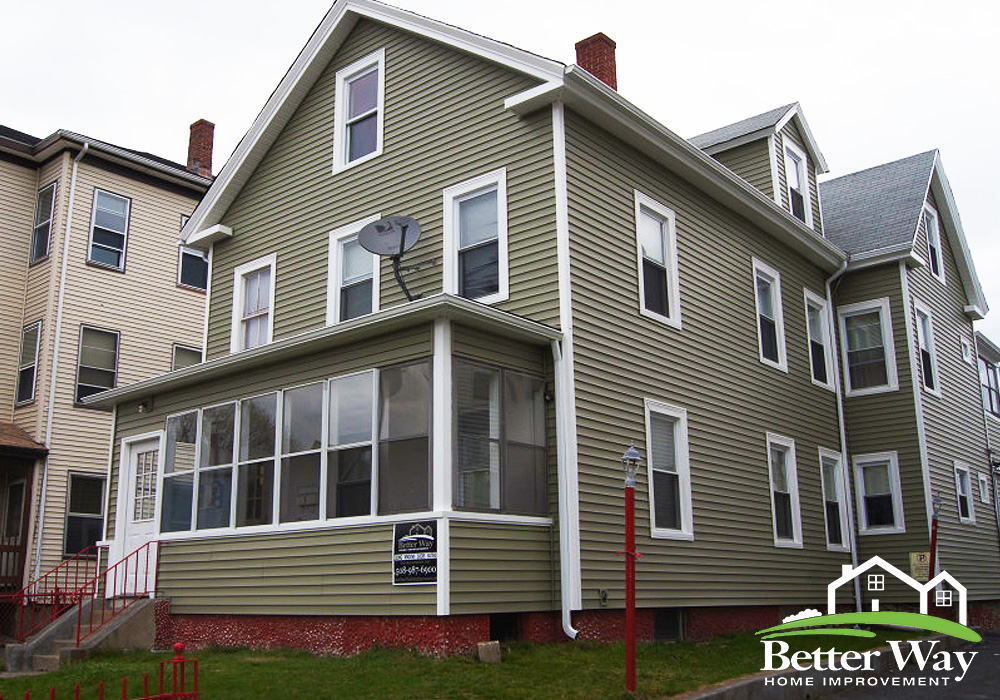
What Gutter Repair & Installation looks like in Douglas
Most calls in Douglas are one of two things: a gutter that’s sagging or leaking on a house that just needs it fixed or replaced in kind, or a full seamless gutter installation tied to a siding job. We form K-style and half-round gutter on site with a truck-mounted machine, so there are no seams to fail over a mill-town winter. Sizing matters more here than in a lot of towns we serve — Douglas gets real ice buildup off the Blackstone Valley cold pockets, and the tree cover on older lots means pine needles and oak leaves loading up a 5-inch gutter fast. We typically size up to 6-inch K-style on homes with steep or complex roof planes, and we check the fascia board condition before we hang anything new, because a lot of the original fascia on these 1800s and early-1900s houses is undersized 1×4 or 1×6 stock that won’t hold a heavy gutter loaded with ice.
On repair calls, we’re usually resetting hangers, replacing a rotted section of fascia, resealing end caps, or correcting pitch so water actually reaches the downspout instead of standing and freezing. On install calls, we’re matching the gutter profile to the house — half-round on the older Greek Revival and farmhouse-style homes near the town common, K-style on the triple-deckers and post-war capes. Guards come up on almost every job as a question, and we’re straight about it: they help on open lots, they clog faster under heavy pine and oak, and they don’t replace cleaning entirely.
What we account for on Douglas homes
Older village-center houses
Some of Douglas's older homes have clapboard exteriors, traditional trim, and rooflines that are less straightforward than those on a basic ranch. Gutter replacement needs to follow the existing roofline without creating drainage problems around porches, additions, valleys, or changes in roof height. Where the existing gutter profile has a visual relationship with the house, we look at the replacement as part of the exterior rather than simply installing the cheapest standard profile.
Ranches and split-levels
Ranch and split-level homes can have long roof runs with several drainage points. A long gutter run needs the right pitch and enough downspout capacity to move water efficiently. Split-levels can also create changes in roof height and wall elevation that affect where water collects. We check those transitions rather than assuming every section of the house can use the same setup.
Fascia and soffit condition
A gutter is only as secure as the surface it is attached to. On older Douglas houses, we may find deteriorated fascia behind an existing gutter. Water can enter around old fasteners or damaged joints for years before the problem becomes obvious. If the supporting material is soft or damaged, simply installing another gutter over it does not solve the underlying issue. We check the attachment area before the new system goes up and explain what needs to be addressed if the fascia or soffit has a problem.
Snow, ice and pine debris
Douglas homes deal with the same seasonal problems common across southern Worcester County. Snow and ice put additional stress on exterior components, while nearby pines can drop needles and small debris into open gutters. Gutter guards can be added where they make sense, but they are not automatically included with every job. The existing gutter condition, roof design, nearby trees, and amount of debris should be considered first.
What we account for on Douglas homes
Inspect the existing system
Board sheathing with no housewrap
A lot of the original wood clapboard in Douglas sits directly over board sheathing with no moisture barrier. When we open up fascia or soffit to hang new gutter, we’re looking for water staining or soft wood that tells us moisture has been getting behind the trim for years. We flag it before we close anything up, not after.
Undersized rakes and returns
Older mill housing here was framed with modest rake boards that were never meant to carry today’s gutter loads, especially with ice. We reinforce or sister the rake where needed before hanging new gutter, so the fastener has something solid to bite into.
Sill rot from grade creep
Over a century or more, dirt, mulch, and pavement build up against foundations, and grade ends up higher than the original sill line. On a lot of Douglas properties this means the bottom few inches of wall and trim have been sitting wet. We check for it during every gutter estimate, because a new gutter system won’t help if water is still wicking up from below.
Lead paint on pre-1978 trim
Anything built before 1978 gets treated as lead paint until proven otherwise, which is most of the housing stock in Douglas’s older sections. We follow lead-safe work practices when we disturb painted fascia or trim — containment, cleanup, the whole protocol — no shortcuts.
Decide b/w repair, replacement
How the job runs
Site walk and measure
We walk the roofline, check fascia and soffit condition, and measure for gutter run and downspout placement. On tight Douglas lots we also figure out where the seamless-forming truck can park and where material staging works without blocking a narrow driveway or shared right-of-way.
Forming and installation
Gutter is formed on site to the exact length needed, no seams. A straightforward single-story repair or partial replacement usually runs one day. A full-house install with fascia repair, guards, and multiple downspouts typically runs one to two days depending on the roof layout and how much trim needs to be addressed first.
Walkthrough and cleanup
We walk the gutter line with you, check pitch and outlet placement, and haul away every scrap of old material. Nothing gets left in the yard or leaning against the garage.
Complete work, check drainage
Douglas jobs tend to run a little slower than a wide-open suburban lot simply because of access. Triple-deckers and cottages close to the street mean the ladder truck and forming equipment have to work around parked cars, tight side yards, and sometimes a shared driveway with a neighbor. We plan for that before the crew shows up, not on the day of.
Recent work in and around Douglas
A common job type in Douglas is a full gutter replacement on a mill-era cottage or triple-decker where the existing gutter is original steel or old aluminum that’s rusted through or pulling nails. We typically find some fascia that needs a section replaced, size up to 6-inch K-style to handle the tree cover and ice, and add guards on request where the lot has heavy overhanging trees. Another regular job is a repair-only call on a cape or ranch near the reservoirs, where the fix is a hanger reset and pitch correction rather than a full tear-off. We don’t invent stories about specific customers or addresses — every job is different, but those two patterns cover most of what we see in town.
Other services we provide in Douglas
Gutters usually come up alongside siding work in Douglas, since both trades deal with the same fascia, trim, and moisture issues on this older housing stock. If your clapboard is original wood or aging vinyl from the 1970s through 1990s, see our siding contractor page for Douglas for repair and full replacement options, including James Hardie fiber cement for homeowners who want to move off wood or vinyl entirely. We also install replacement windows and doors on the same trips when it makes sense to bundle the work and save on staging and access costs.
Frequently Asked Questions
Do you repair old half-round gutters on Douglas's older homes, or only replace them?
We repair half-round where the gutter itself and the fascia behind it are still sound — usually a reseal, a hanger reset, or a section splice. Once the steel or aluminum is rusted through or the fascia behind it is rotted, replacement is the honest answer, and we'll tell you which situation you're in.
My house is pre-1978 — does that change how you handle the gutter work?
Yes. If we're disturbing painted fascia or trim on a pre-1978 house, we follow lead-safe work practices, including containment and proper cleanup. This applies to a large share of homes in Douglas's older sections and it's built into our estimate, not an add-on surprise.
What size gutter do you recommend for Douglas's tree cover and ice?
We size up to 6-inch K-style gutter on most Douglas homes with mature trees or steep roof planes. Standard 5-inch works fine on smaller, simpler roofs, but heavy leaf load and ice buildup are common enough here that we default to checking the larger size first.
How much does gutter repair or installation cost in Douglas?
Simple repairs — hanger resets, resealing, a short section replacement — usually run a few hundred dollars. Full seamless gutter installation on an average house typically runs into the low thousands depending on linear footage, fascia condition, and whether guards are added. We give an exact number after seeing the house, not before.
What happens if you find rot or damage behind the old gutter or fascia?
On board-sheathed houses without housewrap, we find soft or water-stained wood often enough that we expect it. We stop, show you what we found, and give you a price to fix it before we hang new gutter over it. We don't cover up a problem to finish the job faster.
Free estimates in Douglas
Douglas is about 7.8 miles from our shop in Douglas, so we’re in and out of town regularly and can usually get an estimate on the calendar within a few days. Call (508) 506-8957 for a free, no-pressure estimate. We’ll look at your fascia, soffit, and existing gutter condition, give you a straight answer on repair versus full replacement, and put a number in writing before any work starts. If we find rot or lead paint issues once we’re up there, we’ll tell you before we touch anything, not after.