


James Hardie Siding in Sturbridge, MA
If you’re pricing James Hardie fiber cement for a home on Cedar Lake, Big Alum, or one of the other Sturbridge water bodies, the short answer is: it holds up to driven rain better than anything else on the market, but the install has to account for what’s usually hiding behind your current siding first. A lot of the housing stock around these ponds started as seasonal cottages that got closed in for year-round living decades ago, and the wall assembly behind the siding often wasn’t upgraded to match. That matters more with fiber cement than with lighter products, because Hardie board is heavier, it’s fastened differently, and it doesn’t forgive a soft or undersized wall the way some materials do.
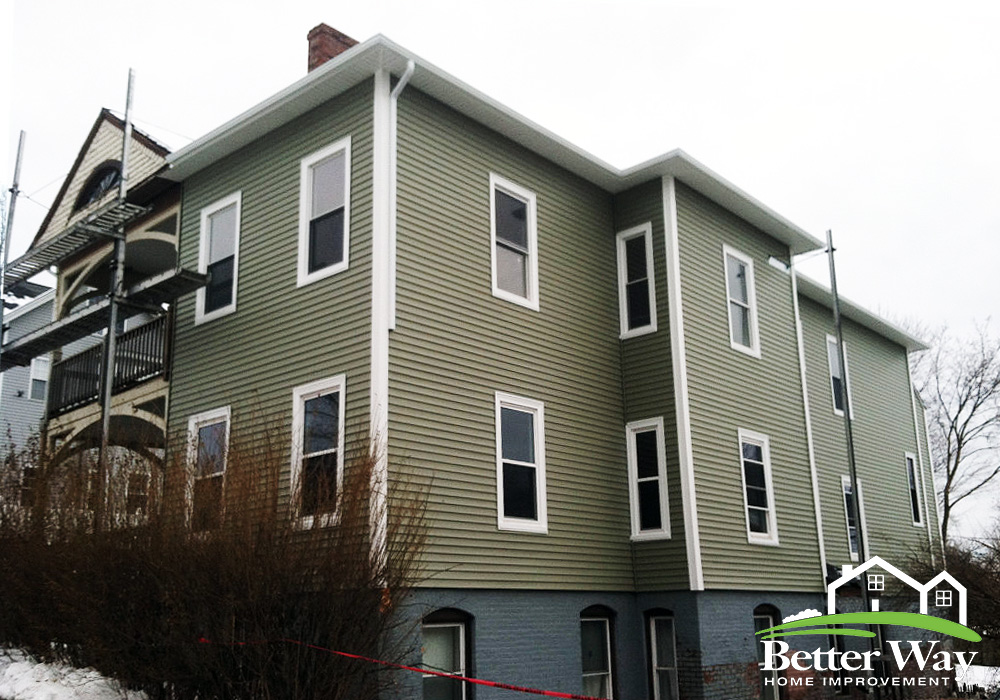
What James Hardie Siding looks like in Sturbridge
On a typical Sturbridge job we’re either re-siding a year-round colonial or cape a half mile off Route 20, or we’re working on a lake-facing cottage that’s been added onto more than once. Both get James Hardie for different reasons. The colonial owners usually want the fire resistance and the fact that it won’t dent from a ladder or a thrown baseball the way vinyl can. The lake-house owners are usually chasing something more specific: a siding that can take sustained wind off the water and repeated wetting without cupping, buckling, or letting moisture track behind it.
Fiber cement is heavier than vinyl or engineered wood, which is exactly why it performs on exposed elevations, but it also means the crew has to plan for the weight and for cutting it correctly. We cut outside with HardieBlade saws and shop-vac attachments, not inside the garage or on the deck, because the silica dust from dry-cutting fiber cement is a real respiratory hazard and it’s not something you want settling on your patio furniture or your neighbor’s pool. Every board is fastened per Hardie’s published nailing pattern for the local wind zone, not just “however the last siding was hung,” because Sturbridge’s water-facing lots see wind loads that a 1980s reside job was never engineered for.
We also talk owners through ColorPlus versus field-applied paint up front. ColorPlus comes from the factory with a baked-on finish that carries its own warranty and holds color longer than site-applied paint, which matters on a lake elevation that gets constant UV bounce off the water. Field paint costs less and gives you more color flexibility, including matching a historic trim scheme in the village center. Neither is wrong. It depends on whether you want to touch up paint again in 10 years or not think about it again in 25 or 30.
What we account for on Sturbridge homes
Older clapboard behind the existing exterior
One of the first things to check on an older Sturbridge house is what sits behind the current siding. A 1970s or 1980s exterior may have been installed over original wood clapboard. Removing it can reveal damaged boards, uneven areas, or sections that need repair before the new siding can be installed. The condition of that layer is part of the project, not something to ignore until the end.
Heavy material on an older wall
Fiber cement is heavier than the lightweight siding it may be replacing. That means the wall surface and fastening locations need to be considered before installation. The crew accounts for the existing substrate, checks areas where the old exterior has failed, and plans the installation around the actual condition of the house rather than assuming every wall is sound.
Cutting and dust control
Fiber cement needs to be cut to fit around windows, doors, corners, and other details. Cutting produces dust, so the work area has to be managed accordingly. That means using appropriate cutting methods and keeping dust from spreading unnecessarily around the property. The goal is to keep the installation controlled while producing accurate cuts for the exterior details.
ColorPlus or field-applied paint
Sturbridge homeowners have two basic finish approaches to consider. ColorPlus siding arrives with a factory-applied finish, while primed siding can be painted after installation. James Hardie says ColorPlus finishes are cured in a controlled factory environment and are designed to provide consistent color and improved resistance to UV-related fading. The right choice depends on the look you want, the available colors, and how you want the finished project handled. We can price the options as part of the estimate.
What we account for on Sturbridge homes
Site visit and scope
Every Sturbridge quote gets adjusted based on what we actually find, not a generic price list. Four things come up often enough that we check for them before we ever write a number down.
Remove, Prepare, Install
Water-side wind and driven rain. Elevations facing Cedar Lake or the Quinebaug watershed take a different weather load than the street side of the same house. We flash and lap those walls tighter, and where the old siding shows chronic staining under the seams, we treat it as a sign the wall behind needs a closer look before new board goes up.
Undersized or converted-cottage framing. A house that started as a three-season camp and got winterized in the 1970s or 80s frequently has studs on wider spacing than code calls for now, or sheathing that was never meant to carry a heavier cladding. We check framing capacity before installation, not after the material is on the truck.
Missing insulation and no vapor control. Converted cottages very often have no vapor barrier and thin or absent wall insulation. Fiber cement doesn’t breathe the same way older wood siding did, so if there’s no vapor control behind it, moisture that used to pass through the wall now has nowhere to go. We flag this at the estimate and price in a proper water-resistive barrier and, where needed, insulation upgrades.
Rot at the water-facing wall. This is the one we check first, before we quote, not after we start tearing off. On lake and pond conversions, the water-side wall is where rot shows up most, usually at the sill and the lower courses. Finding it during the walkthrough means it’s in the number you agreed to. Finding it after demo means a change order nobody wants.
Detail work and final check
How the job runs
Walkthrough and moisture check, day one. We inspect all elevations, but on Sturbridge properties near water we specifically probe the water-facing wall for soft spots, staining, and past patch jobs before we quote anything. This is where we catch the undersized framing or missing vapor barrier issues mentioned above.
Tear-off and substrate repair, typically 1-2 days. Old siding comes off, any rotted sheathing or framing gets replaced, and a proper water-resistive barrier goes on before a single Hardie board is hung. This step runs longer on lake-facing conversions than on standard colonials, because that’s where the surprises usually are.
Install and finish, typically 3-5 days depending on size. Boards go up per Hardie’s nailing schedule for the wind zone, corners and trim get finished to match the house style, and ColorPlus seams get touched up or field paint gets applied if that’s the option chosen. A full single-family reside in Sturbridge generally runs about a week from tear-off to final walkthrough, longer if substrate repair turns up more than expected.
Recent work in and around Sturbridge
A common job type we see in this town is a lake-adjacent cape or ranch, originally a seasonal camp, where the owners want to stop repainting every few years and stop patching soft spots at the base of the water-facing wall. The pattern is usually the same: strip the old cladding, find some rot or undersized framing at the water side, correct it, add a proper barrier, and install James Hardie with tighter fastening on the exposed elevation. We also do a fair number of straightforward colonial and cape resides closer to the village center and along Route 131, where the draw is fire resistance and long-term durability rather than water exposure specifically.
Other services we provide in Sturbridge
Fiber cement isn’t the right fit for every budget or every house, and we quote it alongside vinyl siding installation so owners can compare both honestly. If your existing siding is sound but damaged in spots, our siding repair service handles that without a full tear-off. For homes that need a complete reside but aren’t set on fiber cement, see our siding replacement page. We also install and repair seamless gutters, which matter a lot on lake-facing rooflines where poor drainage is part of why the old wall got wet in the first place, and we replace windows and doors during the same project when it makes sense to do both at once.
Frequently Asked Questions
Why choose James Hardie over vinyl for a Sturbridge lake house?
Fiber cement handles sustained wind and driven rain off the water better than vinyl, which can flex, crack, or blow off in exposed conditions. It's also non-combustible and resists impact damage, both useful on a property that gets weather from an open lake or pond.
Do you check for rot before or after removing the old siding?
Before, whenever possible. On Sturbridge's lake and pond conversions, the water-facing wall is where rot and undersized framing show up most often, so we probe that wall during the walkthrough and price any needed repair into the original quote.
How much does a James Hardie reside cost in Sturbridge?
It depends on square footage, trim complexity, and what we find behind the old siding. Converted cottages with missing vapor barriers or rotted sheathing cost more than a standard colonial reside because of the added substrate work. We give a firm number after the walkthrough, not before.
ColorPlus or field-applied paint, which is better for a water-facing elevation?
ColorPlus holds its factory finish longer under constant sun and moisture exposure, which suits a lake-facing wall. Field paint costs less upfront and gives more color choice but needs repainting sooner. We'll walk you through both options during the estimate.
What happens if you find no insulation or vapor barrier behind the old siding?
It's common on converted seasonal cottages in this area. We flag it at the estimate, price in a proper water-resistive barrier, and recommend insulation upgrades where the wall cavity allows it, rather than closing a bad wall back up with new siding.
Free estimates in Sturbridge
Sturbridge is about 11.0 miles from our shop in Sturbridge, and we quote jobs there regularly, from village colonials to lake-facing conversions. Call (508) 506-8957 for a free estimate. We’ll set up a walkthrough, check the water-facing wall and framing condition before we price anything, and give you a written number that accounts for what we actually find, not a guess. If we turn up rot or missing insulation during the walkthrough, we’ll tell you before you sign anything, not after demo starts.