


James Hardie Siding in Douglas, MA
Most of the calls we get from Douglas start the same way: a homeowner has pulled off a section of old clapboard or a failed vinyl overlay and found board sheathing underneath, no housewrap, and paint that’s probably lead-based because the house went up before 1978. That’s the mill town building stock around East Douglas and the village center in a nutshell — worker cottages and triple-deckers built tight to the lot, framed for wood siding, never meant for anything else. James Hardie fiber cement is the product that respects that construction instead of fighting it. It’s heavier than vinyl, it holds paint or factory finish the way the original clapboard did, and it doesn’t expand and contract against old sheathing the way plastic siding does in a New England winter.
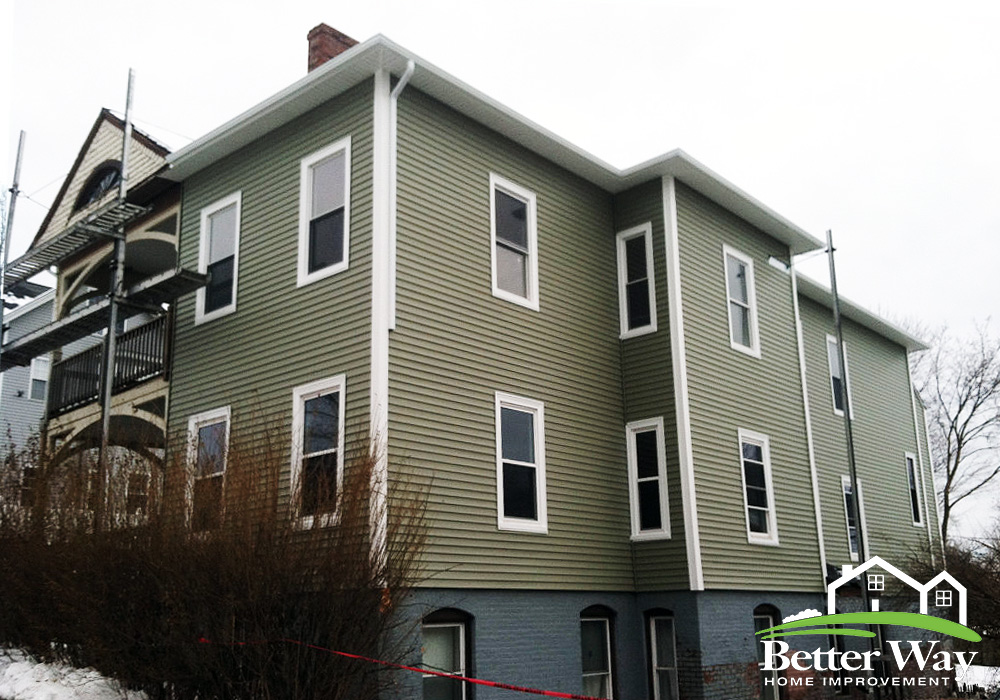
What James Hardie Siding looks like in Douglas
On a typical Douglas job we’re not just re-skinning a wall — we’re dealing with a house that was built for wood and has probably already had one bad siding decision made on it. Fiber cement is the right correction for that. It’s cement, cellulose fiber, and sand pressed into board, so it doesn’t flex, doesn’t dent from a baseball or a ladder tap, and it carries a Class A fire rating that plain vinyl can’t touch. That matters on lots where houses sit twelve or fifteen feet apart, which is common in the older sections of town.
We install Hardie’s HZ5 climate zone product, engineered for the freeze-thaw cycles and moisture swings this part of Massachusetts gets. Most Douglas homeowners choose ColorPlus factory finish over field-applied paint. ColorPlus is baked on at the factory in multiple coats, it’s warrantied against fading and peeling for 15 years, and it means no repainting the whole house five years after we leave. Field paint is still an option if you want a custom color match to a neighboring historic house, but we tell people upfront it will need maintenance sooner.
Cut and dust handling is not a footnote on this job — it’s half the work. Fiber cement throws silica dust when it’s cut, and OSHA takes that seriously for good reason. We cut outside with HEPA-shrouded saws, never inside a garage or breezeway, and we stage cutting stations away from windows and any vegetable gardens, which a lot of these lots still have tucked along the side yard.
What we account for on Douglas homes
Older clapboard behind the existing exterior
One of the first things to check on an older Douglas house is what sits behind the current siding. A 1970s or 1980s exterior may have been installed over original wood clapboard. Removing it can reveal damaged boards, uneven areas, or sections that need repair before the new siding can be installed. The condition of that layer is part of the project, not something to ignore until the end.
Heavy material on an older wall
Fiber cement is heavier than the lightweight siding it may be replacing. That means the wall surface and fastening locations need to be considered before installation. The crew accounts for the existing substrate, checks areas where the old exterior has failed, and plans the installation around the actual condition of the house rather than assuming every wall is sound.
Cutting and dust control
Fiber cement needs to be cut to fit around windows, doors, corners, and other details. Cutting produces dust, so the work area has to be managed accordingly. That means using appropriate cutting methods and keeping dust from spreading unnecessarily around the property. The goal is to keep the installation controlled while producing accurate cuts for the exterior details.
ColorPlus or field-applied paint
Douglas homeowners have two basic finish approaches to consider. ColorPlus siding arrives with a factory-applied finish, while primed siding can be painted after installation. James Hardie says ColorPlus finishes are cured in a controlled factory environment and are designed to provide consistent color and improved resistance to UV-related fading. The right choice depends on the look you want, the available colors, and how you want the finished project handled. We can price the options as part of the estimate.
What we account for on Douglas homes
Site visit and scope
Lead paint on pre-1978 siding
If your house predates 1978 — and a large share of Douglas housing does — we assume lead paint until tested otherwise. Our crews follow EPA RRP lead-safe work practices: poly containment at ground level, HEPA vacuum cleanup, and sealed disposal. This adds time to the tear-off phase but it’s not optional, and it protects your kids, your pets, and your soil.
No housewrap over board sheathing
Original construction here used board sheathing with tar paper at best, and often nothing at all behind the old clapboard. We install a code-compliant weather-resistive barrier over the sheathing before a single piece of Hardie goes up. This is the single biggest performance upgrade on these houses — it’s the layer that was always missing.
Undersized rakes and trim returns
Mill-era cottages were often built with narrow rake boards and tight trim returns that don’t leave room for modern siding thickness plus proper flashing. We rebuild trim dimensions where needed rather than jamming Hardie boards up against undersized wood, which is how you get water intrusion two winters later.
Sill rot from grade creep
Decades of driveway repaving, mulch buildup, and lawn regrading have pushed soil up against a lot of these sills. We check sill and band board condition at tear-off, replace what’s punky, and where we can, we recommend regrading or a drip edge fix so the new siding isn’t sitting against the same problem in ten years.
Remove, Prepare, Install
How the job runs
Site setup and staging
Douglas driveways are often narrow, shared, or shadowed by mature trees close to the house. Before we schedule, we walk the property to plan dumpster placement, material staging, and crew truck parking so we’re not blocking a neighbor’s access on a tight street.
Tear-off and substrate repair
Old siding comes off, sheathing gets inspected board by board, and any rot, especially at sills and around old window flashing, gets cut out and replaced before we move forward. This phase runs longer on Douglas homes than on newer construction because of the lead-safe protocols and the near-certainty of finding something behind the wall.
Housewrap, install, and finish trim
Weather barrier goes on, then Hardie boards, then trim, corners, and flashing details. A typical single-family Douglas home runs 5 to 9 working days depending on square footage, trim complexity, and what we find once the old siding is off. We walk the finished job with you before we call it done.
Detail work and final check
Recent work in and around Douglas
A representative job in this area is a 1920s worker’s cottage near the village center: original wood clapboard, no wrap, a layer of asbestos-cement shingle added at some point over that, and sill rot on the north side where a downspout had been dumping water against the foundation for years. We stripped both layers, tested and handled the lead paint under EPA protocols, replaced about 30 linear feet of sill and band board, added proper housewrap, and finished in Hardie ColorPlus lap siding with matching trim. That sequence — strip, test, repair, wrap, install — is close to the norm for pre-1940 Douglas houses, not the exception.
Other services we provide in Douglas
Fiber cement isn’t the right fit for every budget or every house, and we’re upfront about that. If you want a lower-cost option that still holds up in this climate, our vinyl siding installation work in Douglas uses insulated panels that perform well over properly wrapped walls. If your siding is sound but damaged in one spot — storm damage, a cracked panel, a section pulled loose — our siding repair service can often fix it without a full tear-off. And if you’re past patching and ready for a whole-house project, our siding replacement page walks through how we scope that decision. We also install and repair seamless gutters and replacement windows and doors, both of which we’re usually already on-site for when we open up a Douglas wall.
Free estimates in Douglas
We’re based at 152 Sutton Ave in Douglas, about 7.8 miles from Douglas center. We give free, in-person estimates and we’ll be honest with you about what your house needs, including if fiber cement isn’t the best use of your budget. Call (508) 506-8957 to set up a time. We’ll walk the exterior with you, look at what we can see of the sheathing and trim condition, and give you a written quote before we leave. If lead paint testing is needed, we’ll explain that step and the cost before any work starts, not after.
Frequently Asked Questions
Is James Hardie siding worth it over vinyl for a Douglas house?
For older mill-town construction with board sheathing and no wrap, yes, in most cases. Fiber cement is heavier, holds up better against impact and fire, and pairs well with the housewrap upgrade these houses usually need anyway. It costs more upfront than vinyl, and we'll quote both so you can compare.
My house is from the 1920s. Will you find lead paint?
Assume yes if it predates 1978. We follow EPA RRP lead-safe practices as standard on any Douglas tear-off of that age: containment, HEPA cleanup, sealed disposal. It adds time and modest cost to the tear-off phase, but it's required and it's not something we skip.
What happens if you find rot or bad sheathing once the old siding is off?
On houses this age it's common, not rare, especially at sills and around old flashing. We stop, show you what we found, and quote the repair before continuing. We don't install new siding over rotten substrate.
How much does James Hardie siding cost in Douglas, and how long does it take?
Cost depends on square footage, trim detail, and what condition the sheathing is in once we open the wall, so we quote after an in-person walk rather than by phone. Most single-family Douglas homes take 5 to 9 working days from tear-off to finished trim.
Do you handle narrow driveways and tight lots?
Yes. Many Douglas properties near the village center have narrow shared driveways or limited street parking. We plan dumpster placement and material staging during the estimate visit so it doesn't hold up the schedule or block neighbors.
Why Douglas homeowners choose James Hardie
Douglas properties face plenty of seasonal swings, and James Hardie fiber cement siding holds up to that shifting weather far better than vinyl or wood. It resists moisture, won’t warp, and keeps its color for years.
- Built to handle New England seasons
- Low-maintenance, long-lasting finish
- Wide range of styles and colors