


Siding Replacement in Worcester, MA
Most of Worcester’s housing stock is two- and three-story wood-frame, a lot of it triple-deckers built before World War I and re-sided at some point with aluminum or a first generation of vinyl. When that layer is thirty or forty years old, patching it stops being worth the trip. A full tear-off is usually the honest answer once you’re seeing gaps at the corner boards, soft spots near the sills, or panels that no longer lock together. Replacement means stripping the walls down to the sheathing, dealing with whatever that reveals, and building back up with a system rated for triple-decker exposure. That’s a different job than repair, and it’s priced and scheduled differently too.
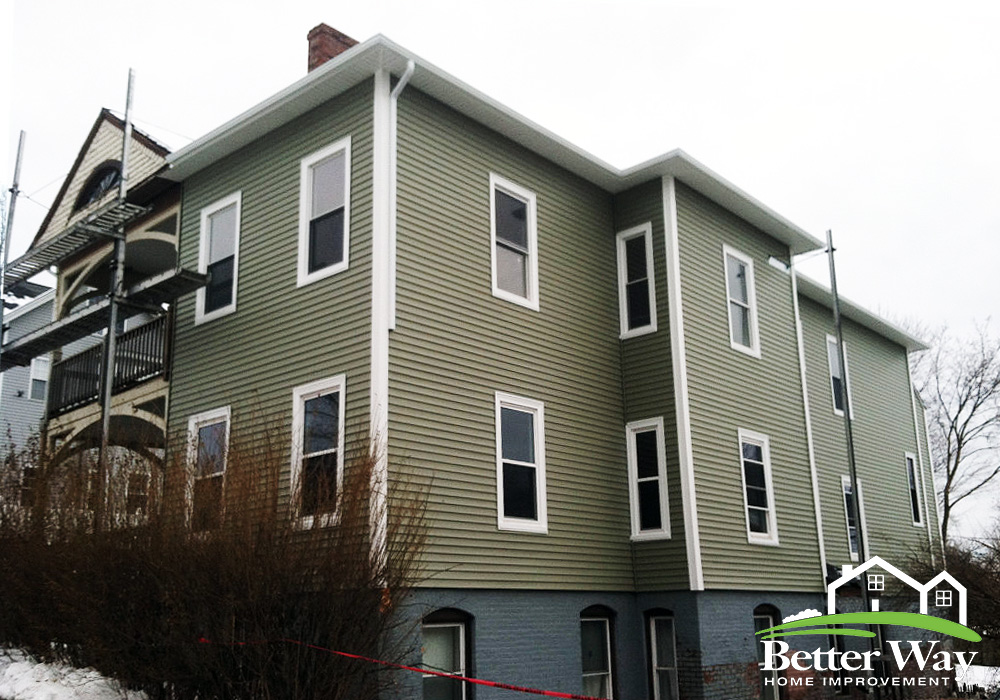
What Siding Replacement looks like in Worcester
On a Worcester three-decker, replacement starts with removal, not installation. We pull the existing siding off in sections, working floor by floor, and that’s where the job actually gets decided. Original clapboard from the early 1900s is often still under a layer of 1960s or ’70s aluminum, and that combination hides a lot: old nail holes, cracked or missing sheathing, and in some cases lead paint on the original wood siding underneath. We test for lead before we start pulling on pre-1978 houses, because Worcester’s older neighborhoods are exactly where that shows up, and it changes how removal and disposal have to be handled.
Once the walls are stripped, we assess the sheathing board by board. Rot around window sills, at the band board where the first and second floor meet, and behind old downspout runs is common on houses that have gone a decade or two without attention. Any soft or compromised sheathing gets cut out and replaced before a single new panel goes up — installing over bad sheathing just buries the problem for the next owner. From there it’s house wrap, flashing at every window and door, and new siding installed to spec, not just nailed up fast.
The other Worcester-specific factor is scale. A three-decker has three times the wall area of a small ranch, and second- and third-floor work isn’t a ladder job. We staff and schedule for that from the estimate stage, so the quote reflects the real height and square footage rather than a generic per-house price.
What we account for on Worcester homes
Older vinyl over original clapboard
A common Worcester replacement starts with vinyl that was installed over older wood siding. During removal, the crew checks what is underneath rather than assuming the original siding can simply be covered again. If the old clapboard is sound and the planned siding system allows it, it becomes part of the preparation decision. If it is damaged or no longer suitable as the base, the affected material is dealt with before the new siding goes on.
Sheathing and hidden wood damage
Water can reach the wall through failed siding, trim, flashing, or openings around windows and doors. By the time the exterior looks damaged, some deterioration may already be behind it. Tear-off provides an opportunity to inspect those areas. Soft or damaged sheathing and localized rot are repaired before the replacement siding covers the wall again. The purpose is simple: do not put a new exterior over a problem that should have been fixed first.
Older village homes and exterior details
Worcester's village areas include older Victorian and Colonial Revival housing with more trim and architectural detail than a basic ranch. Those details affect removal, preparation, measurements, and installation. The replacement plan accounts for corners, window and door openings, trim, transitions, and other areas where a simple wall panel approach does not work. Older homes also deserve a closer look before removing material that may be part of the original exterior.
Removal, disposal, and site access
Replacement creates a different cleanup requirement from a repair. The old siding has to be removed, sorted and taken away, and the work area has to remain accessible while the exterior is open. The estimate accounts for removal and disposal rather than treating tear-off as an afterthought. On a typical Worcester home, the crew works through the exterior in sections so the project can move from removal to preparation and then into the replacement phase.
What we account for on Worcester homes
Site visit, replacement estimate
Worcester’s triple-deckers, capes, and colonials each bring their own quirks. We factor in wall exposure to winter wind and moisture, existing trim and window details, and how utility lines or fencing affect equipment placement.
- Wall height and structure type
- Existing insulation and moisture barriers
- Trim, fascia, and soffit condition
- Neighboring property clearance
Tear-off and wall inspection
Height and staging on multi-family walls
Second- and third-floor exterior walls on a triple-decker need proper scaffold, not extension ladders, especially on the street-facing side where we’re also working close to power lines and neighboring properties. We set staging as part of the plan, not as an afterthought once the crew is on site, which keeps the job moving instead of stalling on day two.
Replacement and cleanup
Tight side yards and street staging
A lot of Worcester’s older neighborhoods were built with narrow side yards, sometimes just a few feet between houses. There’s often no room to stage material or a dumpster beside the house, so we plan for street parking permits and curbside staging up front, and we coordinate that with the homeowner and, where needed, the city before the crew shows up.
Historic districts and permitting
Worcester has several designated historic districts, and some neighborhoods have design review requirements that affect siding profile, exposure, and color even on a straightforward re-side. We pull the necessary permits and handle that review when a property falls inside one of these areas, so the job doesn’t stall halfway through over paperwork that should’ve been sorted before demo started.
What's found once the old siding comes off
On housing stock this old, we plan on finding something — rotted sheathing, old lead paint on original clapboard, or water damage that never showed from the street. We build that expectation into the estimate as a documented allowance, so if we open a wall and find damage, there’s already a clear, agreed process for pricing the fix instead of a surprise change order.
Frequently Asked Questions
How much does siding replacement cost on a Worcester triple-decker?
It depends heavily on square footage, story count, and what we find under the old siding, but a full re-side on a three-decker generally costs more than double a single-family home of similar square footage per floor, mainly due to staging and sheathing repair. We give a firm, itemized quote after walking the property rather than a phone estimate, since the condition underneath varies so much house to house.
Do I need a permit to re-side my house in Worcester?
Yes, most exterior siding replacement in Worcester requires a building permit, and properties in one of the city's historic districts may also need design review for material and color. We handle the permit application and any historic review as part of the job.
What if you find lead paint or rotted sheathing behind my old siding?
On homes built before 1978, we test for lead paint before removal, since a lot of Worcester's original clapboard was painted with it before later aluminum or vinyl went over top. Rotted or damaged sheathing is common on houses that haven't been touched in decades. Both are handled through a documented allowance built into the estimate up front, so there's an agreed process and price rather than a surprise mid-job.
How long does a full siding replacement take?
A single-family home usually takes three to five days. A Worcester three-decker, with its extra height and square footage, typically runs one to two weeks depending on how much sheathing repair is needed and how the staging works on that particular street.
Can you work around tenants in a multi-family building?
Yes. We section off work floor by floor and coordinate timing with owners so tenants aren't left with an open wall overnight. This comes up often in Worcester since so much of the housing stock is two- and three-family.
How the job runs
Assessment and quote
We walk the exterior, check the number of stories, note any historic district status, and look for visible signs of what’s likely underneath — soft spots, gaps, old paint lines showing through seams. The quote breaks out removal, disposal, sheathing repair allowance, and new material and labor as separate line items, so you can see what you’re actually paying for.
Tear-off and sheathing repair
Old siding comes off in sections rather than all at once, which keeps the house weather-protected overnight instead of leaving whole walls exposed. Damaged sheathing is cut out and replaced as we go, and house wrap and flashing go in before any new panel is hung. On a typical Worcester three-decker this stage runs two to four days depending on how much sheathing repair is needed.
Installation, cleanup, and walkthrough
New siding, trim, and any corner and fascia work go up to manufacturer spec, including proper nailing and clearance for expansion. We haul debris off site continuously rather than letting it pile up in a tight yard, and we walk the finished job with the homeowner before calling it done. Most full three-decker re-sides finish in one to two weeks; a single-family cape or ranch is usually three to five days.
Recent work in and around Worcester
A common job we run in Worcester is a full tear-off on a triple-decker where the original clapboard was covered in aluminum siding decades ago. Once we strip a wall, we typically find a mix of sound original wood and a few sections of sheathing that softened up from old flashing leaks around window heads. Those get cut out and replaced, the whole building gets wrapped, and we re-side floor by floor working around tenants where the property is owner-occupied on one floor and rented on the others. Absentee landlords tend to want the fastest, most durable option with minimal call-backs; owner-occupants often want to be more involved in color and trim decisions. We price and schedule for both, but the underlying tear-off and repair work is the same regardless of who’s holding the checkbook.
Other services we provide in Worcester
Siding replacement is often the point where other exterior problems surface. If your existing vinyl is basically sound but a few sections are cracked or a storm knocked panels loose, our siding repair service in Worcester may be the better fit instead of a full tear-off. If you’ve already decided on vinyl and want to talk product lines, styles, and colors rather than removal and sheathing, see our vinyl siding installation page for Worcester. Some homeowners use a re-side as the moment to move up to fiber cement — ask us about James Hardie siding while we’re doing the estimate. We also install and repair seamless gutters and replace windows and doors, both of which are worth bundling into a siding job since the staging and access are already in place. Ask about combining any of these when you call.
Free estimates in Worcester
Better Way Home Improvement is based at 152 Sutton Ave in Worcester, about 10.5 miles from most Worcester neighborhoods. We’ve been doing this long enough to have won Angie’s List Super Service Awards from 2013 through 2019, and we’re licensed and insured for the multi-story work Worcester’s housing stock requires. Call (508) 506-8957 for a free estimate. We’ll set a time to walk the exterior, look at stories, access, and any historic district status, and give you a written quote broken out by removal, repair allowance, and installation — no pressure, no obligation to book on the spot. After you call, next step is scheduling that walk-through, usually within a few days.