


Vinyl Siding Installation in Hudson, MA
Most of Hudson’s vinyl siding calls come from two neighborhoods: the older capes and ranches off Washington Street and River Road built in the 1950s and 60s that got their first vinyl re-side sometime in the 1980s or 90s, and the colonials from the 90s and 2000s built out near Wilkins Farm and the Cellucci Drive area that still have their original builder-grade panels. Both are now due. If your siding is chalking when you rub it, bowing between the studs, or cracked from the last few winters, you’re looking at a full-wall project, not a patch. That’s what this page covers.

What Vinyl Siding Installation looks like in Hudson
A full installation on a Hudson house starts with the panel itself. We install .044 to .046 gauge panels as a baseline — thick enough to resist oil-canning and wind flutter, which matters on the open lots around Wilkins Farm and Chestnut Street where houses catch more crosswind than in tighter, tree-lined parts of town. Homeowners here ask about insulated vinyl more than almost anywhere else in our service area, and it’s a fair question on a 1960s cape with minimal wall insulation to begin with — insulated panel adds an R-value bump and stiffens the wall, but it costs more per square and isn’t always the right call on a house that’s getting new windows or an energy retrofit at the same time. We walk through that tradeoff on site rather than defaulting to the upsell.
Color retention is the other thing Hudson buyers push on, and they’re right to. A lot of the fading and chalking we get called out for is 20+-year-old siding that never had a real fade warranty behind it. Current panel lines we install carry manufacturer color-retention warranties that are prorated but real, and we go over what’s actually covered versus what’s marketing before anyone signs anything.
Under the panel, the work that actually keeps water out of the wall is housewrap, properly lapped and taped, plus new flashing at every window, door, and roof intersection. J-channel and corner posts get cut and fit tight — not caulked over gaps — because a sloppy corner is the first place these houses show trouble again in five years.
What we account for on Hudson homes
Original clapboard under older vinyl
One common condition on older Hudson homes is original clapboard underneath later vinyl siding. The existing layers need to be checked before new siding is installed. If the underlying material is sound and suitable, the installation can be planned around it. If there is deterioration or an uneven surface, that condition needs to be addressed before the new siding goes on.
Victorian and Colonial Revival details
Village-center homes often have more exterior details than a basic ranch. Porches, trim, windows, and changes in wall depth can affect how siding panels and accessories need to be laid out. J-channel, corner posts, and other trim are installed around those features so the new siding follows the house instead of making the house conform to a generic layout.
Aging 1970s and 1980s vinyl
Older vinyl can become brittle, faded, warped, or difficult to match. Replacement siding also gives homeowners an opportunity to update the panel profile, color, insulation, and exterior trim. The crew checks the existing siding and the areas around windows, doors, corners, and other transitions before establishing the installation plan.
Housewrap and flashing
Vinyl siding is not the waterproofing layer of the wall. Proper flashing and housewrap help manage water behind the siding. Before the panels are installed, the wall assembly and openings are considered so moisture problems are not simply hidden behind a new exterior.
What we account for on Hudson homes
Measure and plan
Hudson’s mix of older capes, colonials, and newer builds each bring their own quirks. We look closely at wall condition, moisture history, trim details, and existing insulation before recommending panel style, thickness, and flashing approach for your home.
Prepare the exterior
Original board sheathing on 1950s-60s capes
Houses built off Washington Street and River Road in the postwar years often have board sheathing under the old siding instead of plywood or OSB. It changes how we fasten — nailing pattern and depth have to account for gaps between boards, and we check for rot at the sill and around old fastener holes before a single new panel goes up. This is one reason we always look under the first course before quoting a final number.
Complete the details
Open, exposed lots catching wind-driven weather
The newer colonial subdivisions near Cellucci Drive and Wilkins Farm sit on bigger, more open lots with less tree cover than the older village streets. That means more direct wind and rain hitting the walls. We spec heavier gauge panel and pay closer attention to fastener spacing on those elevations so panels don’t rattle loose or bow over a few Nor’easter seasons.
Builder-grade panel from the 1990s-2000s reaching end of life
A lot of the colonials built during Hudson’s growth years came with entry-level vinyl that was never meant to last 25-30 years. It’s usually thinner gauge, faded unevenly, and the trim pieces have shrunk and pulled away from window casings. We treat these as full tear-off jobs rather than trying to match discontinued colors with partial repair.
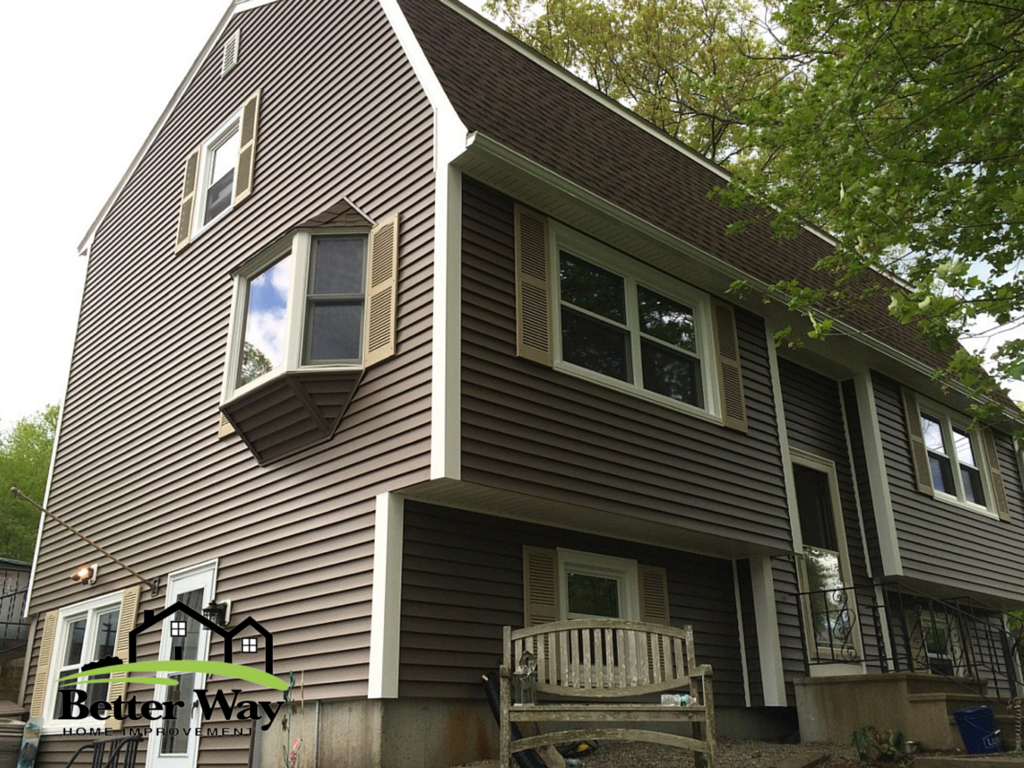
Older double-hung windows needing new J-channel and flashing
Plenty of Hudson capes still have original or early-replacement windows. When we side around them we rebuild the J-channel and flashing detail rather than reusing what’s there, since old flashing is usually the actual source of water intrusion, not the siding itself.
Frequently Asked Questions
How much does vinyl siding installation cost in Hudson?
Most full re-sides on Hudson single-family homes run in the range of several thousand dollars up into the higher five figures depending on square footage, panel gauge, whether it's insulated, and how much sheathing repair is needed once the old siding comes off. We give a firm number after a walkthrough, not a phone estimate.
Do you find rot or damage behind old siding on Hudson homes?
Often, yes. Houses built with original board sheathing in the 1950s and 60s, and homes with old flashing around windows, commonly have some soft or damaged sheathing once we pull the first course. We stop and show you what we find before repairing it, and it gets priced separately from the siding itself rather than buried in the estimate.
How long does a full vinyl siding installation take?
A typical single-family home in Hudson takes 3 to 5 working days from tear-off to finished trim, depending on the size of the house, number of corners and windows, and weather. Larger colonials with more detail can run longer.
Is insulated vinyl siding worth it on an older Hudson cape?
It depends on the house. Insulated panel adds R-value and a stiffer wall, which helps on a 1960s cape with thin original insulation, but it costs more per square. If you're also replacing windows or adding wall insulation separately, standard panel may make more sense. We go through the actual tradeoff on site rather than defaulting to one answer.
What panel gauge and warranty do you install?
We install .044 to .046 gauge panel as our standard, which holds up to wind and impact better than thinner builder-grade product. Panels carry manufacturer color-retention and fade warranties, which we go through line by line so you know what's actually covered before you sign anything.
How the job runs
Walkthrough and measurement
We measure every wall, check the sheathing at a few spots by pulling old panel, and confirm window and door trim details. This is also when we talk through panel gauge and insulated versus standard for your specific house. Most Hudson estimates take under an hour on site.
Tear-off, housewrap, and flashing
Old siding comes off down to the sheathing. We repair any rot found, install housewrap, and flash every penetration — windows, doors, hose bibs, electrical. This step is where the actual weatherproofing happens, and it’s the part that’s invisible once the job’s done.
Panel installation and detail work
Panels go up starting at the bottom starter strip, working up with correct overlap and nail spacing to allow for expansion. Corner posts, J-channel, and trim around windows and doors get fitted last. A typical single-family home in Hudson runs 3 to 5 working days depending on size, number of corners, and weather.
Recent work in and around Hudson
A common job for us in Hudson is a full re-side on a 1960s cape where the original owner had added vinyl over the original wood clapboard sometime in the 80s. Pulling that off usually turns up a mix of sound board sheathing and a few soft spots around the sills and old dryer vent penetrations. We replace the damaged sheathing, wrap and flash the whole wall correctly, and install new insulated or standard panel depending on what the homeowner’s budget and energy goals call for. On the newer colonials near Wilkins Farm, the more typical call is a straight re-side of failed builder-grade siding — same tear-off and wrap process, less sheathing repair, more trim and corner work because those houses tend to have more architectural detail to match.
Other services we provide in Hudson
Not every Hudson job needs a full re-side. If your siding is sound but has storm damage, a few cracked panels, or trim pulling loose in spots, our siding repair service in Hudson handles that without tearing off good material. If you’re set on a full tear-off and rebuild but haven’t decided on vinyl versus fiber cement, our siding replacement page covers that decision in more detail. We also handle James Hardie fiber cement siding for homeowners who want a heavier, non-vinyl option, plus seamless gutters and replacement windows and doors — both of which we’re often doing alongside a siding job anyway, since it’s easier to flash windows correctly when the wall is already open.