


Vinyl Siding Installation in Southborough, MA
If you own a colonial off Deerfoot Road or a cape near Fayville that’s still wearing its original vinyl from the 1980s or 90s, you already know the signs: panels that have gone from white to chalky gray, seams that gap in the cold, maybe a cracked run from the last nor’easter. Southborough’s larger lots make staging easy, which usually means a faster, cleaner install than in tighter neighborhoods. This page covers what a full vinyl siding installation actually involves here — panel choice, insulation, trim detail — not a repair patch.

What Vinyl Siding Installation looks like in Southborough
Most of the calls we get from Southborough are from owners of postwar capes and ranches, plus a good number of 1980s-2000s colonials built during the town’s growth years off routes 9 and 30. A lot of that housing stock got its first vinyl siding job decades ago, and it’s aging out at the same time across whole streets. That means we’re often quoting several houses on the same road in a given season.
For a full install, we start with panel profile. Double 4-inch and double 5-inch clapboard profiles are the standard choice for these home styles, and we carry both standard .042-.044 gauge panels and heavier insulated panels that add rigid foam backing. On a Southborough colonial with a lot of wall square footage, the insulated option often pencils out — better sound dampening, a straighter finished look because the foam backs out minor sheathing waves, and a modest R-value bump that matters in a house that’s already 30-40 years old on windows and doors.
Color retention is the other conversation every homeowner here has with us, because they’ve all seen a neighbor’s siding fade unevenly or chalk out within ten years. We install product lines with baked-in UV-stable resin and a real fade warranty in writing, not a verbal promise. J-channel, corner posts, and starter strip all get sized to the panel profile chosen — undersized trim is the single biggest cause of buckling and rattling on jobs we’ve torn off in this area. Housewrap goes down fresh, seams taped, and flashing gets rebuilt at every window and door head before a single panel goes up.
What we account for on Southborough homes
Original clapboard under older vinyl
One common condition on older Southborough homes is original clapboard underneath later vinyl siding. The existing layers need to be checked before new siding is installed. If the underlying material is sound and suitable, the installation can be planned around it. If there is deterioration or an uneven surface, that condition needs to be addressed before the new siding goes on.
Victorian and Colonial Revival details
Village-center homes often have more exterior details than a basic ranch. Porches, trim, windows, and changes in wall depth can affect how siding panels and accessories need to be laid out. J-channel, corner posts, and other trim are installed around those features so the new siding follows the house instead of making the house conform to a generic layout.
Aging 1970s and 1980s vinyl
Older vinyl can become brittle, faded, warped, or difficult to match. Replacement siding also gives homeowners an opportunity to update the panel profile, color, insulation, and exterior trim. The crew checks the existing siding and the areas around windows, doors, corners, and other transitions before establishing the installation plan.
Housewrap and flashing
Vinyl siding is not the waterproofing layer of the wall. Proper flashing and housewrap help manage water behind the siding. Before the panels are installed, the wall assembly and openings are considered so moisture problems are not simply hidden behind a new exterior.
What we account for on Southborough homes
Measure and plan
Older colonials and farmhouses common around Southborough often have uneven wall lines, stone foundations, and varied trim depths. We factor in slope, existing moisture barriers, window flashing, and roofline details so panels sit flush and drain properly for years ahead.
Prepare the exterior
Larger lots, longer wall runs
Southborough properties tend to sit on bigger parcels than what we see closer to Worcester, which means more linear feet of wall per house and, often, more corners on additions or garages built on later. We plan panel runs to minimize seams on the most visible elevations — usually the street-facing wall and anything visible from a driveway — and stagger joints on secondary walls where a seam matters less.
Complete the details
Original vinyl from the 1980s-90s reaching end of life
A big share of the installs we quote in town are replacing that first-generation vinyl. It was often installed directly over old wood clapboard or board sheathing without much attention to flashing at penetrations. We pull it back far enough during tear-off to check the sheathing and flashing underneath before we commit to a start date, not after.
Mix of house ages and wall conditions on one street
Because Southborough grew in waves, a single road can have a 1960s ranch next to a 2001 colonial. Wall assemblies differ — older homes may have board sheathing with gaps, newer ones plywood or OSB. We adjust fastener spacing and furring decisions house by house rather than running one spec for the whole neighborhood.
Quote comparison and warranty terms
Southborough homeowners call more contractors before deciding than most towns we serve, and they ask sharper questions about warranty language. We write down the panel gauge, the manufacturer’s fade warranty period, and our own labor warranty on the estimate itself, so it’s easy to compare against another contractor’s quote line by line.
Frequently Asked Questions
What panel profile is best for a Southborough colonial or cape?
Double 4-inch clapboard profile is the most common fit for capes and ranches, while double 5-inch works well on larger colonials with more wall area. We'll match profile to the house style during the estimate rather than run one default across every job.
Is insulated vinyl siding worth it in Southborough?
For homes with original 1980s-90s windows and doors still in place, insulated panels add a modest R-value bump and a straighter finished look by backing out minor sheathing waves. It costs more upfront than standard gauge panels, so we quote both so you can compare.
What happens if you find damage behind the old siding?
On siding this old it's common to find a spot of soft sheathing or failed flashing, usually at a window head or corner. We stop, show you the damaged area, and give you a price to repair it before continuing. It's not automatic — plenty of tear-offs come up clean — but we plan the schedule with some flexibility for it.
How long does a full vinyl siding installation take on an average Southborough house?
Most single-family capes and colonials run three to five working days from tear-off through final trim. Larger homes with more wall area, dormers, or multiple stories can take longer, and weather can push the schedule.
What does vinyl siding installation cost in Southborough?
Cost depends on wall square footage, panel gauge, and whether you choose insulated panels, so we don't quote a number without seeing the house. We give every Southborough homeowner a free, written estimate with the panel spec and price broken out so it's easy to compare against other quotes.
How the job runs
Estimate and wall assessment
We walk the exterior, check the condition of the current siding and any visible sheathing at corners or vents, and measure wall square footage. You get a written quote with panel profile, gauge, and color options the same visit or within a day or two — usually within a week for the full walkthrough-to-quote cycle.
Tear-off and sheathing check
Old siding comes off in sections so we can inspect sheathing and flashing as we go. On a typical single-family colonial or cape this stage runs one to two days depending on wall area and how many layers of old material are underneath.
Housewrap, trim, and panel install
New housewrap goes on, corner posts and J-channel are set to the chosen profile, and panels go up starting from the base. A full install on an average Southborough home runs three to five working days total from tear-off through final trim, weather permitting. Larger colonials with more wall area or dormers can run longer.
Recent work in and around Southborough
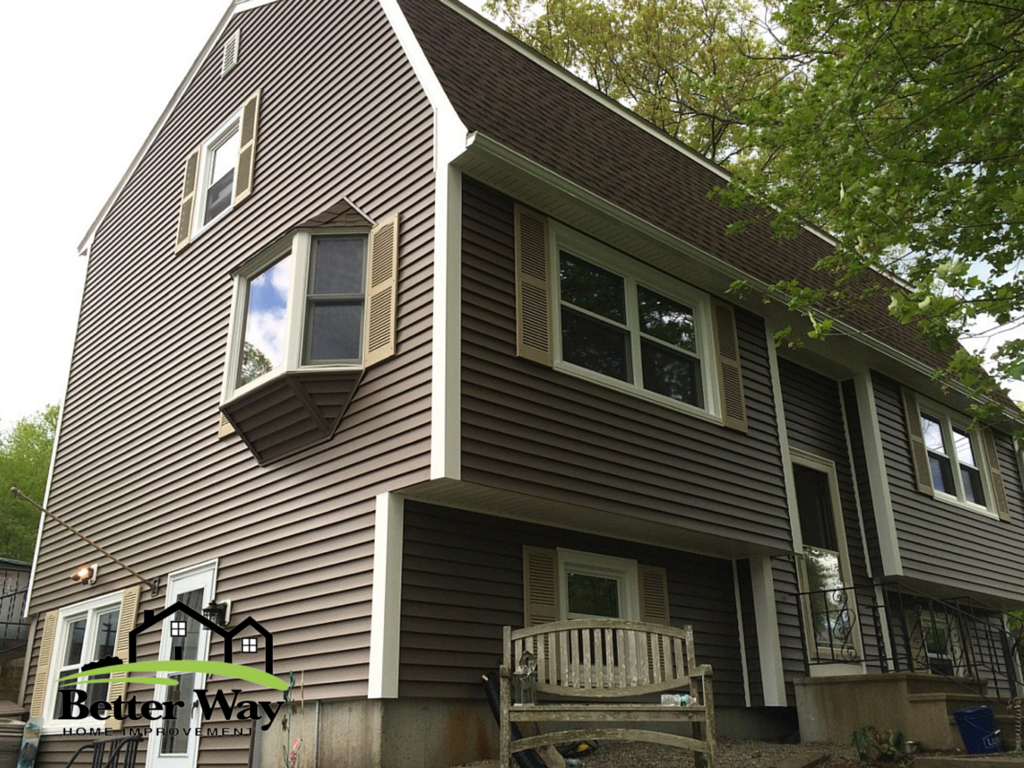
A common job type in this town is a full re-side on a 1970s or 80s cape where the original vinyl had chalked out and a few panels had cracked from age and sun exposure on the south-facing wall. The tear-off turned up board sheathing that was sound but had a couple of spots where old flashing at a window head had failed and let moisture into the wall cavity over the years. We replaced the damaged sheathing section, rebuilt the flashing correctly, and installed insulated double 4-inch panels with a 30-year fade warranty. That’s a fairly typical scope for this housing stock — not every job turns up hidden damage, but on siding this old, it’s common enough that we always plan for the possibility rather than assume clean sheathing.
Other services we provide in Southborough
If your siding is more patchwork than whole-wall — a few cracked panels, storm damage on one elevation, or gaps around trim — our siding repair service in Southborough may be the faster, cheaper fix. When the decision is closer to a full tear-off and you’re weighing options against a repair, our siding replacement page for Southborough covers that decision in more detail. Some homeowners in town are also looking at James Hardie fiber cement siding instead of vinyl, particularly on higher-visibility colonials. We also handle seamless gutters and replacement windows and doors, both of which often get done alongside a siding job since the crew and staging are already on site.
Free estimates in Southborough
Southborough is about 21.7 miles from our shop in Southborough, and it’s a regular stop for us — we’re usually out there weekly during the season. Estimates are free and we’ll give you a written quote with panel profile, gauge, and warranty terms spelled out, not a verbal ballpark. Call (508) 506-8957 to set up a walkthrough. After you call, we’ll schedule a visit to measure the wall area and check the current siding condition, then follow up with the written quote, usually within a few days.