


Vinyl Siding Installation in Rutland, MA
Rutland sits on open, elevated ground west of Worcester, and most of the homes we look at here are capes and farmhouses built long before vinyl siding existed — some going back to the 1800s. That means the framing underneath was never square to begin with, and the wind coming across those long, unbroken approaches on Route 122 or up around the common hits a wall of siding harder than it would in a sheltered subdivision. Vinyl siding installation on a Rutland house is as much about what’s happening behind the panel as the panel itself.

What Vinyl Siding Installation looks like in Rutland
On a full-wall installation job, we’re stripping the old material down to the sheathing, correcting what needs correcting, and building the wall system back up in the right order: housewrap, flashing at every window and door, furring where the wall plane is out of true, then the panel itself. In Rutland we specify a heavier .044-.046 gauge panel for open, exposed elevations — thinner standard panel tends to oil-can and rattle on a house that takes wind head-on with no trees or neighboring structures to break it up.
Insulated vinyl siding comes up a lot in these conversations, and for good reason. A lot of Rutland’s older homes have minimal wall insulation to begin with, and insulated panel adds an R-value bump plus a stiffer, straighter appearance on walls that aren’t perfectly flat — which describes most of the pre-1900 stock out here. We’ll walk you through both options with real numbers rather than pushing one over the other.
Color retention matters more here too. Full sun exposure on south and west walls with no windbreak fades cheap panel faster than it should. We install product lines that carry a real fade warranty, not just a paint-chip promise, and we go over what that warranty actually covers before you sign anything.
Corner posts, J-channel, and trim detailing get more attention on an irregular colonial or farmhouse wall than on a modern build with square corners. Old houses settle unevenly. We custom-fit trim rather than force a standard reveal, which is where a lot of cut-rate installs go wrong and start showing gaps within a couple of winters.
What we account for on Rutland homes
Original clapboard under older vinyl
One common condition on older Rutland homes is original clapboard underneath later vinyl siding. The existing layers need to be checked before new siding is installed. If the underlying material is sound and suitable, the installation can be planned around it. If there is deterioration or an uneven surface, that condition needs to be addressed before the new siding goes on.
Victorian and Colonial Revival details
Village-center homes often have more exterior details than a basic ranch. Porches, trim, windows, and changes in wall depth can affect how siding panels and accessories need to be laid out. J-channel, corner posts, and other trim are installed around those features so the new siding follows the house instead of making the house conform to a generic layout.
Aging 1970s and 1980s vinyl
Older vinyl can become brittle, faded, warped, or difficult to match. Replacement siding also gives homeowners an opportunity to update the panel profile, color, insulation, and exterior trim. The crew checks the existing siding and the areas around windows, doors, corners, and other transitions before establishing the installation plan.
Housewrap and flashing
Vinyl siding is not the waterproofing layer of the wall. Proper flashing and housewrap help manage water behind the siding. Before the panels are installed, the wall assembly and openings are considered so moisture problems are not simply hidden behind a new exterior.
What we account for on Rutland homes
Measure and plan
Rutland’s mix of older farmhouses and newer builds means every wall behaves differently. We factor in existing sheathing, moisture patterns, window and trim depth, and local weather exposure so the new siding fits properly and holds up over time.
Prepare the exterior
How the job runs
Complete the details
What's often found behind the old siding
On houses this age, we don’t assume the sheathing is clean once the old siding comes off. We commonly find soft board sheathing from decades of moisture wicking in around old nail holes, some knob-and-tube era wiring stapled to studs that needs an electrician’s eyes before we close the wall back up, and occasional evidence of old horsehair plaster patch work from early renovations. None of this stops the job. It does mean we build in time to document what we find, price any necessary repair separately, and get your sign-off before we cover it with new material. We don’t seal problems behind new siding and hope for the best.
Recent work in and around Rutland
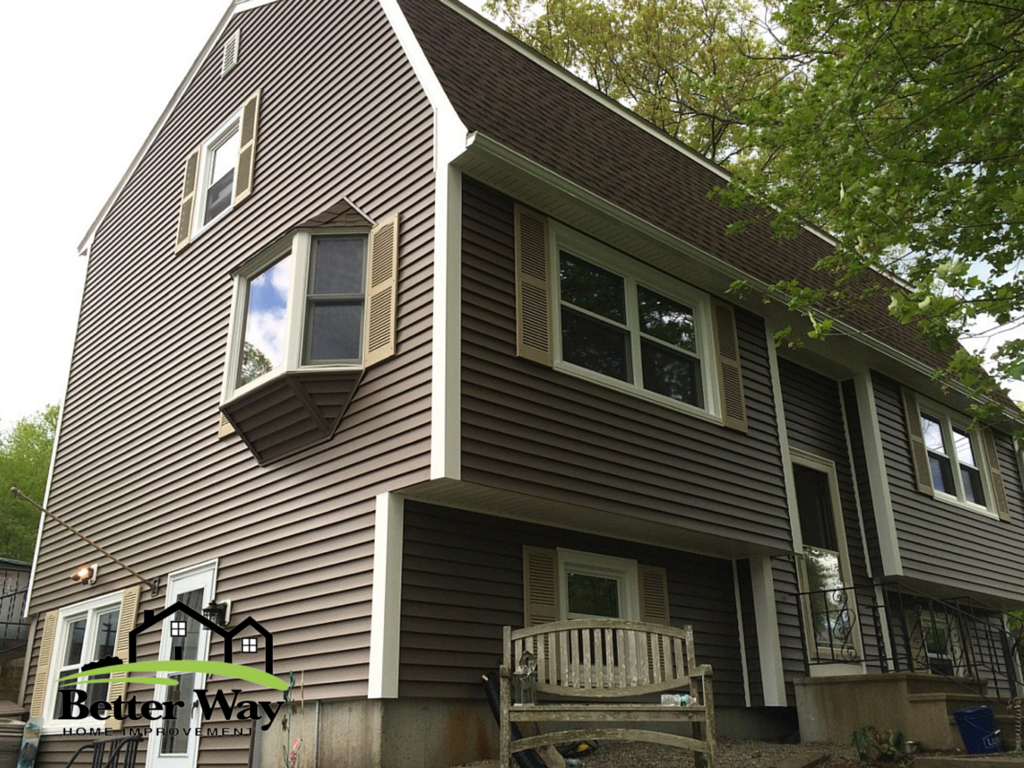
A typical project we run in this area is a full tear-off and re-side on a 1900s-era farmhouse-style home: original clapboard long since covered by a first-generation vinyl job from the 1980s that had chalked, cracked at the corners, and pulled away from the fascia in spots. The re-side involves stripping both layers back to the original board sheathing, replacing sections of rotted sill and rim joist trim, wrapping the whole house in housewrap with proper window and door flashing, then installing insulated vinyl panel with new corner posts and J-channel throughout. Jobs like this typically run several days longer than a straightforward re-side on a newer home, mostly because of the extra prep work on an out-of-square wall.
Other services we provide in Rutland
If your siding is showing isolated damage rather than full failure, our siding contractor page for Rutland covers repair and general siding work for the town. Homeowners weighing a full tear-off against patch repairs should also look at our siding replacement page for Rutland, which walks through that decision in more detail. Some Rutland homeowners choose James Hardie fiber cement instead of vinyl, especially on historic-district-adjacent properties where the town’s guidelines favor a wood-look material — we install that too. We also handle seamless gutters and replacement windows and doors, both of which often get addressed in the same visit since we’re already up on ladders and pulling trim.
Frequently Asked Questions
How much does vinyl siding installation cost on a Rutland home?
Full-wall installation on an older Rutland farmhouse or cape typically runs higher than a standard ranch or newer colonial because of the added prep: furring out-of-square walls, replacing soft sheathing, and custom-fitting trim on irregular corners. We give exact numbers after an on-site walk-through rather than a phone estimate, since the condition behind the old siding drives a real share of the cost.
How long does a full siding installation take?
A standard-size home usually takes about a week from tear-off to final trim. Older Rutland homes with extra sheathing repair or unusual wall geometry can run several days longer. We give you a specific timeline once we've seen the house.
Does the town of Rutland have restrictions on siding for older homes?
Rutland doesn't have a formal historic commission covering the whole town, but some properties near the common or on designated historic parcels may have restrictions on visible exterior changes. We check with you before ordering material if your property is in a sensitive area.
What happens if you find rot or old wiring behind my siding?
We stop, document it, and show you before covering anything back up. Repair work gets priced separately from the siding install itself, and you approve it before we proceed. We don't install new panel over problems.
Is insulated vinyl siding worth it for a Rutland house?
For older homes with thin or no wall insulation, and for walls exposed to open wind with no windbreak, insulated panel usually makes sense. It adds R-value and holds a straighter line over an uneven wall. We'll show you the cost difference against standard panel so you can decide.
Free estimates in Rutland
We’re based in Rutland, about 17.9 miles from Rutland center, and we quote jobs out this way regularly. Call (508) 506-8957 for a free estimate. We’ll come look at the house, measure the walls, check what’s going on underneath where we can, and give you a written price for the job — not a range that changes once we get on site. If you decide to move forward, we’ll schedule the work and walk you through the material choices before crews show up.