


Vinyl Siding Installation in Woodstock, CT
If you’re pricing vinyl siding installation for a Woodstock property, the first thing to know is that most jobs out here run on older Cape and farmhouse-style homes set well back from the road, often with a long gravel or paved drive and heavy tree cover on at least one side of the house. That changes how a crew stages material and equipment before it changes anything about the siding itself. Woodstock’s antique housing stock — plenty of it pre-1900 with additions bolted on over the decades — means walls are rarely square and trim details vary from one side of the house to the other, so installation has to be measured and detailed wall by wall, not assumed from a single elevation.

What Vinyl Siding Installation looks like in Woodstock
A full-wall installation in Woodstock starts with the panel itself. We install .044 and .046 gauge double 4 and double 5 clapboard profiles, and where a homeowner wants a quieter, straighter wall — common on the older farmhouses where the original sheathing has some waviness to it — we’ll spec an insulated panel with a foam backer that also bumps up the R-value on a house that likely has little to no wall insulation to begin with. Color retention matters more here than in a lot of towns because these homes sit under mature oak and maple canopy with dappled, uneven sun exposure; a panel with a weak fade warranty will show streaking between the shaded and exposed sections within a few years. We use products backed by a lifetime, transferable fade warranty so that doesn’t become a five-year-later phone call.
Housewrap goes on before a single panel does, lapped and taped at every seam, with flashing detailed around every window, door, and roof-to-wall intersection. On the antique homes we work on in Woodstock, the sheathing behind the old siding is sometimes board sheathing rather than plywood or OSB, which changes how fasteners bite and how the housewrap gets attached — it’s not a problem, but it’s not something you treat the same as a 1985 ranch either. J-channel and corner posts get cut and fit to the actual wall dimensions on site, not off a stock measurement, because so little on these houses is a standard 8-foot run. The result is a wall system that’s sealed, insulated where it needs to be, and finished with corner and trim work that actually lines up.
What we account for on Woodstock homes
Original clapboard under older vinyl
One common condition on older Woodstock homes is original clapboard underneath later vinyl siding. The existing layers need to be checked before new siding is installed. If the underlying material is sound and suitable, the installation can be planned around it. If there is deterioration or an uneven surface, that condition needs to be addressed before the new siding goes on.
Victorian and Colonial Revival details
Village-center homes often have more exterior details than a basic ranch. Porches, trim, windows, and changes in wall depth can affect how siding panels and accessories need to be laid out. J-channel, corner posts, and other trim are installed around those features so the new siding follows the house instead of making the house conform to a generic layout.
Aging 1970s and 1980s vinyl
Older vinyl can become brittle, faded, warped, or difficult to match. Replacement siding also gives homeowners an opportunity to update the panel profile, color, insulation, and exterior trim. The crew checks the existing siding and the areas around windows, doors, corners, and other transitions before establishing the installation plan.
Housewrap and flashing
Vinyl siding is not the waterproofing layer of the wall. Proper flashing and housewrap help manage water behind the siding. Before the panels are installed, the wall assembly and openings are considered so moisture problems are not simply hidden behind a new exterior.
What we account for on Woodstock homes
Measure and plan
Every town in the Quiet Corner has its own set of conditions that change how a siding job gets planned and run. Here’s what comes up most on Woodstock properties specifically.
Antique and irregular framing
Homes built before 1900, and the additions stacked onto them since, rarely have consistent wall dimensions from one elevation to the next. We measure each wall independently rather than assuming symmetry, and we budget extra time for corner and trim fabrication on houses where nothing is quite plumb.
Heavy tree cover and long service drives
Wide lot spacing and mature tree lines mean our trucks and staging need more room to maneuver, and material often has to be hand-carried further from the driveway than it would on a tighter suburban lot. We plan delivery and staging on the site visit, not on installation day, so the crew isn’t improvising around a 200-foot driveway with a load of panel.
Connecticut licensing and permitting
Woodstock sits in Connecticut, not Massachusetts, which means Connecticut Home Improvement Contractor (HIC) registration and Connecticut permitting rules govern the job, not the rules we’d use on a Massachusetts town ten minutes down the road. We confirm our HIC registration covers the scope of work before we ever write a quote, and we pull the correct town permit rather than assuming reciprocity with our home state.
What’s behind the old siding
On housing stock this old, it’s common to find rot at sill plates, undersized or missing flashing, or in some cases old board sheathing that needs partial replacement once the original siding comes off. We don’t price around a guess — we flag it during the estimate walk-around where visible, and we handle anything found mid-job as a documented change order before we close the wall back up.
Prepare the exterior
How the job runs
Most Woodstock installations move through three stages. First, the site visit and measure — we walk the exterior, check every elevation, look at what’s accessible behind existing siding where trim is loose or damaged, and confirm the Connecticut permit and HIC paperwork before we quote a number. Second, prep and installation — housewrap, flashing, and panel go up wall by wall, typically over 3 to 6 working days for an average single-family home depending on square footage, trim complexity, and how much of the old material needs to come off first. Third, final trim, cleanup, and walkthrough — corner posts, J-channel, and any fascia or soffit work get finished, the site gets cleared of old material and packaging, and we walk the house with the homeowner before calling the job done.
Complete the details
Because Woodstock sits about 12.5 miles from our Woodstock shop, we build travel time into the schedule up front rather than treating it as an afterthought. That means one crew, one mobilization, and a realistic start-to-finish window instead of a job that gets pushed back every time something closer to home comes up.
Recent work in and around Woodstock
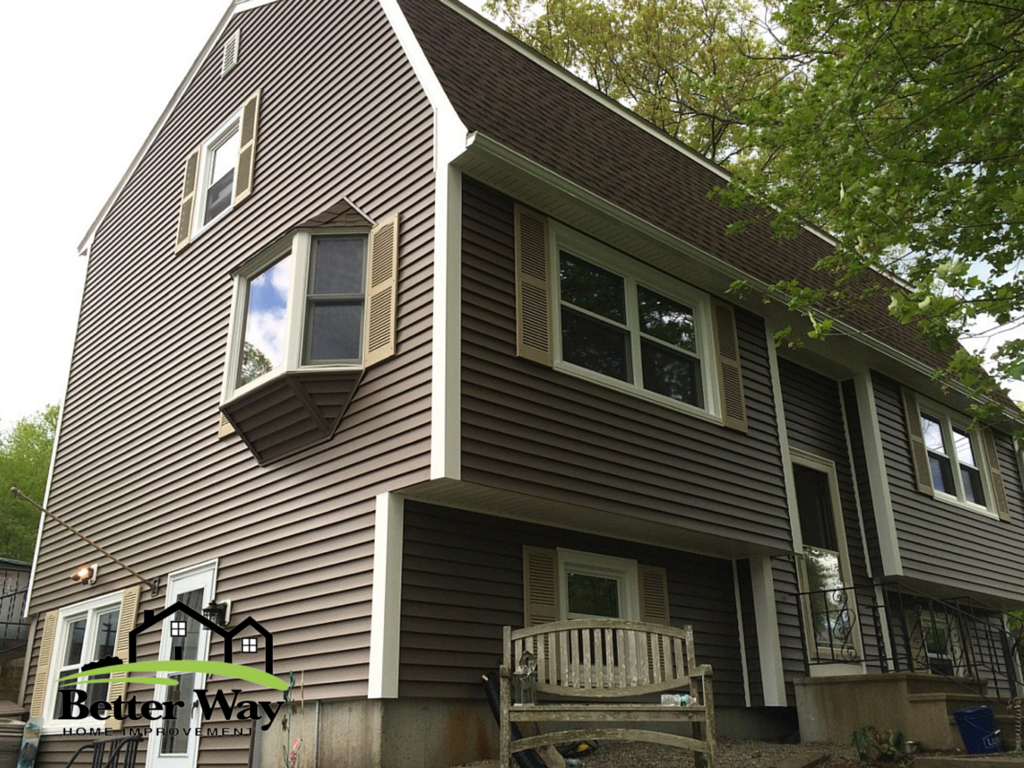
A typical project we run in this part of the Quiet Corner is a full re-side on an older farmhouse or Cape where the existing vinyl — often original to a 1980s or 1990s remodel — has chalked, faded unevenly under tree cover, or started pulling away from J-channel at the corners. The work usually involves stripping the old panel down to sheathing, correcting any flashing that was never properly detailed the first time around, and installing a new insulated or standard panel system with attention paid to matching trim across additions that were built at different times. We don’t publish customer names or addresses, but this is the job type that makes up the bulk of our installation work in Woodstock and the surrounding towns.
Other services we provide in Woodstock
Vinyl siding installation is one piece of the exterior work we do for Woodstock homeowners. If your siding has isolated damage rather than a full-wall problem, our siding repair service handles that without a full tear-off. For homes where the decision has already been made to strip everything down and start over, our siding replacement page covers that process in detail. Some homeowners in this area choose James Hardie fiber cement siding instead of vinyl for a heavier, more fire-resistant wall system. We also handle seamless gutters and replacement windows and doors, both of which often get scheduled alongside a siding project since the crew and staging are already on site. For a broader look at how we approach siding work across the county, see our main vinyl siding installation page, and for general contractor information specific to this town visit our Woodstock siding contractor page.
Frequently Asked Questions
Does Massachusetts or Connecticut licensing apply to a Woodstock siding job?
Connecticut rules apply. Woodstock is in Connecticut, so the job falls under Connecticut Home Improvement Contractor (HIC) registration and Connecticut permitting, not Massachusetts requirements. We confirm our HIC registration covers the scope of the job before writing a quote.
How much does vinyl siding installation cost in Woodstock, CT?
Cost depends on square footage, panel type, trim complexity, and how much prep work the old wall needs. Insulated panels cost more upfront than standard panels but add R-value, which matters on older Woodstock homes with little existing wall insulation. We give exact numbers after a site walk-around, not over the phone.
How long does a full siding installation take on a Woodstock home?
Most single-family homes take 3 to 6 working days once installation starts, depending on square footage and how much old material has to come off first. Homes with irregular framing or multiple additions run toward the longer end of that range.
What happens if you find rot or damage behind the old siding?
On Woodstock's older housing stock, it's common. If we find rot at sill plates, missing flashing, or damaged sheathing once the old siding is off, we stop, show you what we found, and document it as a change order before closing the wall back up. We don't price around problems we haven't seen yet.
Can new vinyl siding go over the board sheathing common on older Woodstock homes?
In most cases yes, once housewrap and flashing are correctly detailed over it. If the board sheathing is deteriorated or too uneven, we'll recommend addressing that section first so the new panel lies flat and fastens properly.
Free estimates in Woodstock
We’re based in Woodstock, Massachusetts, about 12.5 miles from Woodstock, and we quote jobs in this town regularly. A free estimate gets you a real number based on an on-site walk-around, not a phone guess. Call (508) 506-8957 to set one up. After you call, we schedule the site visit, measure and inspect the exterior, confirm Connecticut HIC and permitting requirements for your address, and give you a written quote before any work is scheduled. Better Way Home Improvement is licensed and insured, and has won Angie’s List Super Service Awards every year from 2013 through 2019.